 2 months ago
130
2 months ago
130

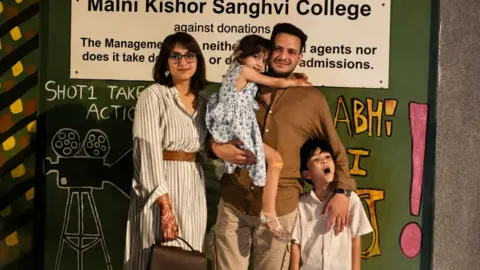 Imtiyaz Ali
Javed, his wife Mariam and their two children died in the Air India plane crash last year
When I called Imtiyaz Ali to ask if we could meet, nearly a year after a plane crash killed his brother Javed, his sister-in-law Mariam, and their two children, we first decided to speak at his home in Mumbai.
Hours later, he changed his mind. "Let's meet at the hotel instead," he said.
Later, beneath the dim lights of a business hotel in Mumbai, he explained why.
Javed and his family had built a life in the UK, but they returned often to Mumbai to see Imtiyaz and the rest of the family. But after the crash, the house no longer felt quite the same. Something in it had shifted irreversibly - altered in ways the routines of ordinary life could neither explain nor repair.
"It feels," Imtiyaz said carefully, "like Javed is still there."
His mother Farida Bano would later put it more simply: "He follows me everywhere," she told the BBC. "Day and night."
In a few weeks, investigators are expected to release their final report into the crash of Air India Flight AI171, the Ahmedabad-to-London flight that fell from the sky less than a minute after takeoff last June. There was only one survivor among the 242 people on board.
For a year, the families of the victims have lived with unanswered questions: what happened in the cockpit, why the aircraft lost thrust, whether the disaster was human error, mechanical failure or something else entirely.
I had met Imtiyaz twice before, in Ahmedabad, in the stunned days after the crash, when families were still waiting for DNA confirmation to identify their loved ones. Back then he spoke with the dazed logic of someone still bargaining with reality. "Maybe he will come back," he told me then.
Nearly a year later in Mumbai, the disbelief had faded - the waiting remained.
"This confusion, this limbo haunts us," he said, describing the absence of closure about what had happened.
The Alis were, in many ways, an ordinary Mumbai family shaped by migration and sacrifice. Their father died early, and the children were raised largely by their grandmother in Mumbai while their mother worked in Dubai for many years.
Javed eventually moved to the UK, part of the vast stream of Indians who leave home searching for financial stability abroad but remain emotionally tethered to their families.
Imtiyaz remembered how inseparable his brother and mother had been. "The whole day they would be talking," he said. Then he paused. "And now," he said, "the silence is what kills her."
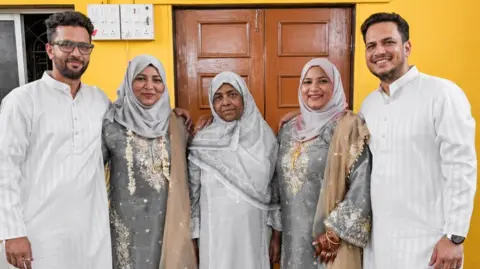 Imtiyaz Ali
The family celebrated Eid together last year - it was just days before the crash
For days after the crash, they tried to shield their mother, a heart patient, from the truth.
Air India officials and doctors advised caution. A psychologist was brought in. Her heart was fragile, and they feared the shock might kill her too.
So the news was delivered in fragments. First: there had been an accident. Mariam and the children were injured. Pray for them. Hours later: Mariam was critical. "What about Javed?" she kept asking. "What about the children?"
"I lied to her," Imtiyaz said. "I told her they were fine."
Even before anyone spoke plainly, she sensed something was wrong. "When my son left, he didn't call me for two days," she said. "He never did that." Relatives tried to reassure her, but the silence unsettled her. "I couldn't sleep," she said. "I kept asking: where is my son?"
Eventually, they flew her to Ahmedabad under the pretext of visiting a sick relative. The moment she entered the hotel room where the family was gathered, she said, she knew.
"I told her the plane had crashed," Imtiyaz recalled. "Javed was dead."
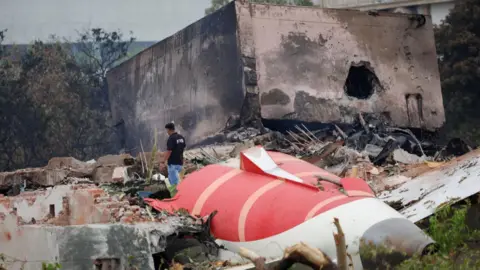 Reuters
There was just one survivor among the 242 people on board. Nineteen people were killed on the ground
As he spoke, the summer heat pressed against the city outside. The family, he said, was trying to move forward, but grief remained woven into their days. His mother speaks of Javed in the present tense. His favourite dishes still appear at family meals, and conversations between siblings still pause at the point where his voice would have filled the silence.
The hardest period came in September, when his mother's heart condition worsened. Doctors inserted three more stents, bringing the total to five. Stress, they warned, was aggravating her heart disease, diabetes and blood pressure. "When she cries missing Javed," Imtiyaz said, "her sugar levels shoot up."
Around the same time, his frustration with Air India and Tata Group officials deepened.
He said the family spent months seeking updates on the investigation, the return of belongings and promised medical support, often receiving vague or delayed responses.
Action, he felt, came only after media attention or public pressure. At one point, he says, doctors arranged through Tata-linked assistance programmes took months to assess his mother.
"We trusted them," he said quietly. "We thought they would stand with us."
The BBC has reached out to Air India for comment on the family's allegations.
Air crash investigations are complex and often take months. Under international aviation rules, final reports are generally expected within a year. An interim report in this case was released a month after the crash.
But for families, the technical details only added to the pain. "We live in a modern country," Imtiyaz said. "Why must we wait a year for answers?"
Like many of those who died, Javed had spent years working abroad to support his family back home.
The brothers had even begun planning a business in Dubai together. "And then," Imtiyaz said, staring down, "right before the best part of life began, he was gone."
Beside him, his mother gave a small, almost imperceptible shrug. "I don't care about the report anymore," she said. "Can any report bring my son back?"
For her, the loss now lives in smaller memories: the dinner the night before Javed left for Ahmedabad, "so merry," she recalled. The first long visit from her grandchildren, who "hugged me so tightly they didn't want to leave".
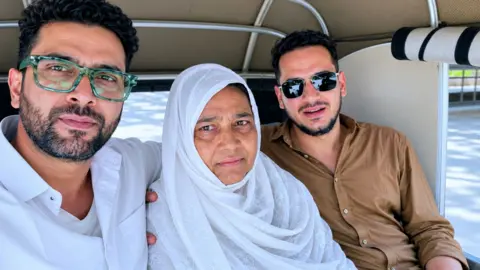 Imtiyaz Ali
Javed's mum Farida Bano (centre) says her sons are her life - she can't bear the pain of losing one
Javed fussed over her throughout the trip, taking her shopping and insisting she buy 15 new outfits.
"I told him, 'Why? Am I going to a wedding?'" she said, beginning to cry.
On his final night in Mumbai, he slept with his head in her lap. "He said he would come back soon."
In the evenings, when the heat over Mumbai begins to soften, she goes alone to the graveyard, carrying food he loved - mutton stew, fish fry, sometimes mangoes - packed as if he might still return.
She lowers herself slowly; the stents in her heart have made movement difficult. Then she speaks to him.
"Look, I am here, my son," she calls softly. "I came to see you."
The day the family received Javed's damaged suitcase from the airline, nobody opened it.
"It's kept away," Imtiyaz said. "We don't touch it."
Tormented by such moments, Imtiyaz became consumed by the search for answers - writing emails to airlines, hiring lawyers and trying to understand what caused the crash.
At one point, relatives sent him to Dubai to pull him away from it. The panic attacks came afterwards. "Sometimes I wake up shaking," he said. "I feel like I'm back there - hearing the news for the first time."
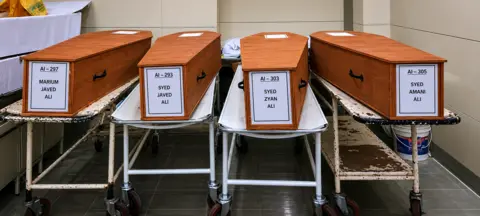 Imtiyaz Ali
Imtiyaz says he went through agony before the family received the bodies of Javed, Mariam and their children
For months, Imtiyaz believed the investigation report might eventually bring peace.
But what finally steadied him was something else.
A few weeks after the burial, his elder sister sent him an old audio message from Javed.
In the message, recorded before the crash, Javed described a dream: two angels had come for him and, before taking him away, bathed him in a fragrance that smelled of roses.
"When I woke up," Javed said in the recording, "I could still smell it."
Imtiyaz sat silently after listening to it, tears welling up.
In Islamic tradition, martyrdom is associated with spiritual purity, and families sometimes find comfort in describing such deaths as honoured. After the funeral, relatives told Imtiyaz that Javed had died an honourable death. At the time, he said, he could not believe them.
But hearing his brother's voice changed something.
"This," he said quietly, "was the answer I needed. He is at peace."
The investigation may eventually explain how the plane crashed. But the voice note taught him how to continue living.
Outside, evening had begun settling. Somewhere, the call to prayer rose through the humid air.
"There are some questions," Imtiyaz said, "that only the dead can answer."