 1 month ago
82
1 month ago
82

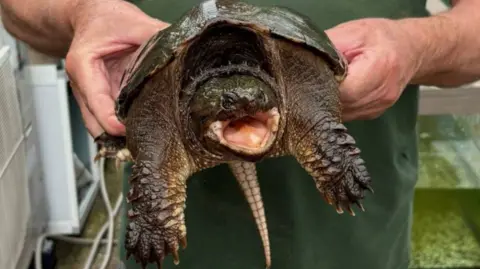 Chris Newman
The turtle was likely released by an "irresponsible owner"
An American snapping turtle with a bite that feels like "trapping your finger in a car door" has been found in a stream at a Welsh beauty spot.
The turtle with his beak-like jaws and native to North and Central America was found at Penllegare Valley Woods, Swansea.
"They're not going to attack, but if you pick one up it will defend itself and likely bite – it would feel like trapping your hand in a car door," said Chris Newman, director of the National Centre for Reptile Welfare, where the turtle was taken to after rescue.
Newman said it was likely left there by an "irresponsible owner", stressing it is illegal to release non-native species into the wild because of the biodiversity impact.
Newman said the centre often sees species of turtles released, but snapping turtles were a worry when it came to other wildlife.
"They're predators – they take fish and frogs, but our biggest concern is that they feed on mammals," he said.
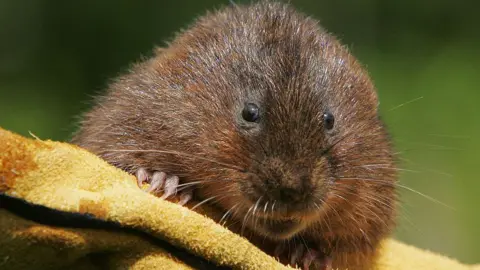
Newman said it was particularly concerning for the native endangered water vole, which he described as the snapping turtle's "top snack".
Once commonly found across Wales, water voles – living along waterways - have undergone significant decline and are listed as endangered due to threats from habitat loss and predators.
"It's really important to stress that it is illegal to release non-native species into the wild," said Newman, recommending that snapping turtles are always removed, something the centre can help with.
 Getty Images
Snapping turtles are a particular risk to water voles
He also urged people not to try and capture snapping turtles themselves, saying they would likely try to defend themselves by biting.
"You're not going to lose a finger, but it would feel like trapping your hand in a car door – it would certainly ruin your day," he said.
Newman also said snapping turtles would be unlikely to bite humans paddling in the water, but would target mammals living there such as water voles.
The turtles mainly hunt by hiding under water and ambushing their prey, he said.
"And if a water vole went over the top of that, that would be the end of that water vole."