 2 months ago
111
2 months ago
111
Emily Unia,BBC Englandand Jonathan Fagg,BBC England Data Unit

 BBC
BBC
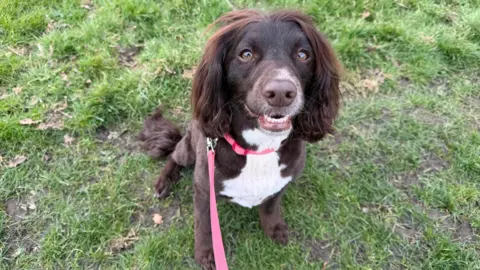
The Royal Veterinary College said cockapoos like Dolly were more likely to display problem behaviours when compared to poodles or cocker spaniels
Mixed-breed dogs like cockapoos, labradoodles and cavapoos are more likely to display "undesirable behaviours" than their purebred parents, according to a new study from the Royal Veterinary College (RVC).
"Doodle" dogs, where a poodle is crossed with a different breed, have become popular and have a reputation for being easy to handle and train.
However, the RVC said those dogs "do not always behave as expected, particularly regarding training, anxiety and aggression".
Animal charity Dog's Trust said a pet's breed was "not a reliable indicator" of an individual dog's behaviour, with both health and socialisation being key factors.
According to the results of the study, cockapoos in particular displayed more aggression and rivalry when it came to other dogs.
RVC researchers received valid responses from the owners of 9,402 UK dogs through an online survey conducted from 21 February to 21 April 2023.
They compared popular designer doodle breeds - cockapoos, labradoodles and cavapoos - to their purebred parent breeds across multiple behaviour categories.
The results showed designer doodles differed from their purebred parents in just over half of all comparisons.
Researchers looked at problem behaviour such as a fear of traffic or loud noises, separation-related issues or excitability.
They found that in 82% of cases where one parent would display some problem behaviour, their doodle offspring were likely to show a more exaggerated version of that behaviour.
Some owners reported finding it extremely difficult to train their dog or impossible to leave their dog alone.
The study said that as the cocker spaniel, for instance, was designed to flush out game from dense areas of woodland and grassland, the dogs were bred to have high energy, mental resilience and intelligence, which could be "more of a problem in pet homes".
It added that when a cocker spaniel was bred with a poodle, those characteristics - combined with them having smaller crossbred offspring - could result in more problem behaviour.
Dr Rowena Packer, senior lecturer in companion animal behaviour and welfare science at the RVC and senior author of the paper, said: "These aren't the kind of behaviours we want to ignore. They're not benign.
"Preconceived beliefs, such as the idea that designer crossbreeds are naturally easy to train or are safe with children, can have serious consequences if they aren't supported by evidence."
The study also found differences between the owners of crossbreed and purebred dogs.
Crossbreed owners were more likely to be first-time dog owners and more likely to use non-professional sources of training advice, such as social media or friends and family.

Viv, pictured with Dolly, said she was "a lovely and loving dog, but has come with a lot of uncertainties"
Viv Smith, from Washington in Tyne and Wear, got Dolly, a cockapoo, in September 2021 after her previous dogs, two boxers, had died.
The 50-year-old was influenced by the growing popularity of doodle-type dogs and had heard they were easier to handle and train.
"I'd heard so many good reports about them... the breed was so out there, like everywhere you went," she said.
But Dolly soon started displaying anxious and fearful behaviour which developed into increasing aggression. She attacked family members, including Viv's three-year-old granddaughter.
"It hasn't just been the once or the twice. This is the third time she's actually bitten," Smith said. "I'm at the point now where I feel I don't trust her."
The vet prescribed medication for Dolly and Smith is seeking help from a behaviour specialist.
She said she was extremely cautious when out walking Dolly, always using a lead and head collar, but worried regularly about another incident.
"My biggest fear is what's next with Dolly?" she said.
She said she would not recommend the breed, especially for families with children.
"I would never tell anyone to get a cockapoo," she added. "I can't promote it."
The RVC said the study highlighted the importance of owners thoroughly exploring the characteristics of any breed - purebred or crossbred - before getting a dog.
It stressed prospective owners should use reliable sources such as behavioural professionals to help ensure their expectations align with the breed's known personality characteristics.
It also highlighted the importance of prospective owners meeting the parents of any puppy they were considering buying to see how those dogs behaved with visitors.
Karol Watson Todd, co-director of the Cockapoo Club of Great Britain, an organisation that promotes responsible breeding practices, said the study was "useful because it helps us look at dog behaviour more closely".
"But we do believe that dog behaviour is influenced by many factors, not just the breed alone," she said.
Watson Todd said responsible breeding, proper socialisation and informed owners were "all key to making sure cockapoos continue to be the wonderful companions that so many families enjoy".
"Popularity of a breed can unfortunately attract irresponsible breeding in any type of dog," she added.
Dom Burke, behaviour policy officer at Dog's Trust, said while the study was "interesting", there were so many other influences on behaviour than breed lines.
"Health is a big one. Their socialisation, their experiences, what's going on around them, the environment they're in at any one time," he said.
He said a dog's behaviour could also be affected by any stress its mother suffered during pregnancy.
"As the demand for certain breeds increases, we see a lot more unscrupulous breeding going on, including really poor breeding practices and puppy smuggling," he said.
Burke also highlighted the importance of seeking qualified professional behaviour support, "not just when there are behaviour issues emerging, but for training and socialisation - all dogs require good socialisation."
He added that while many people knew poodles and spaniels required a lot of exercise, "that same kind of consideration might not necessarily be given by everyone towards a cockapoo".
 Hannah Molloy
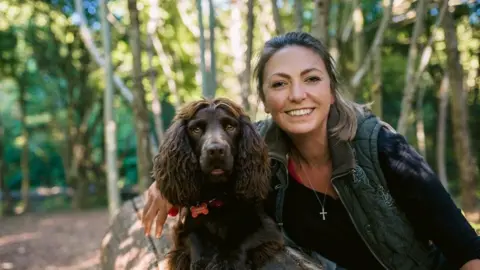
Dog behaviour expert Hannah Molloy, pictured with her spaniel Falkor, said it was vital prospective owners saw pups with their parents
Dog behaviour expert Hannah Molloy said doodles could be prone to resource-guarding aggression because they were a mix of two retrieving breeds.
"Teaching them to share from a young age by offering swaps rather than demanding drops or taking things out of their mouths is important," she said.
She also raised concerns over designer crossbreeds being bred by puppy farms, leading to bad behaviour and bad health.
She said doodle coats could also be a problem, adding: "They need a lot of grooming, or their coats become felted and matted.
"Dogs might be walking around in a lot of pain which will affect their behaviour."