 3 months ago
117
3 months ago
117
6 hours ago
Nick TriggleHealth correspondent

 EPA
EPA
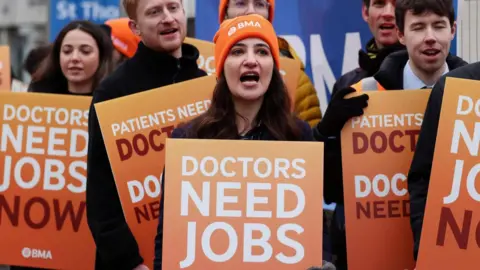
Resident doctors in England are beginning a six-day strike at 07:00 BST on Tuesday – their 15th in a long-running dispute over pay.
It promises to cause significant disruption to services, with resident doctors (formerly called junior doctors) making up nearly half of the medical workforce in the NHS.
Senior medics are being drafted in to provide cover in emergency settings, but it means some pre-planned treatments and appointments are having to be cancelled.
The walkout by British Medical Association members comes after talks between the government and doctors' union broke down last month.
Adrian Emery, 55 and from Nottinghamshire, is one of those affected. He was due to have a telephone appointment on Tuesday after having a number of mini strokes – or TIAs as they are known – in January. It has left him with hearing problems.
The appointment was meant to be his first follow-up to review his medication and talk to a specialist. It was initially rescheduled for mid June, but that has also been cancelled now. He does not know when he will be seen.
"I'm very worried, because my grandfather actually had a very serious stroke. I hope I don't have a full stroke before I am seen," he told BBC News.
Despite receiving pay rises worth 33% over the past four years, the BMA argues doctors are still being paid a fifth less than they were in 2008 once inflation is taken into account.
Dr Jack Fletcher, chair of the BMA's resident doctor committee, said: "It's very regrettable and I am very sorry to any patients who are affected by this industrial action."
But he said he did not think it was "unreasonable or unfair" for doctors to ask for more pay given the real-terms cuts they had experienced already and the fact it was likely to worsen in the future given that inflation was expected to rise because of the Iran war.
He said strike action was "wholly avoidable" if the government was willing to negotiate.
"We are not asking for pay restoration overnight," he added.
A Department of Health and Social Care spokesman said the government had offered resident doctors a "generous deal" and it was disappointing the BMA had pressed ahead with strike action.
"Our attention and that of leaders across the NHS is now on protecting patients, staff and our NHS by minimising disruption to the health service."
Latest polling from YouGov suggests 53% of people oppose the strikes, with 38% supporting them.
The government offered the BMA a package of measures last month in a bid to end the dispute - although the union has said elements of it were watered down at the last minute.
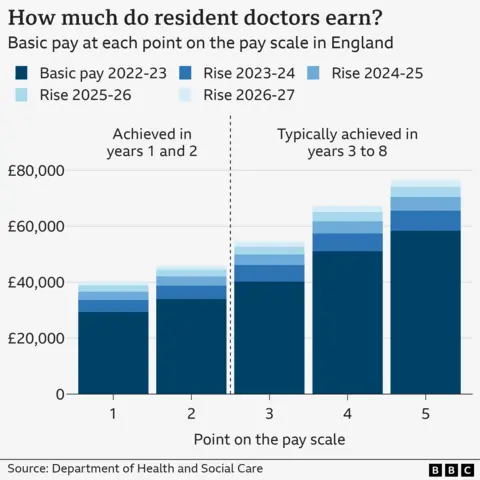
It included covering out-of-pocket expenses, such as exam fees, faster pay progression through the five salary bands that span resident doctor training and extra speciality training posts that doctors move into after year two following graduation.
The first tranche of these – 1,000 of them – were meant to be created this summer. But the government has now withdrawn those after the BMA announced it was taking strike action. It comes after 30,000 applicants applied for 10,000 jobs last summer, although some of these were foreign doctors.
The government maintains it will not negotiate on pay after giving resident doctors the most generous pay rises in the public sector.
They have just received a 3.5% pay rise, but this is something that has been given to all doctors as part of the annual pay review process.
It means starting salaries are now just over £40,000, with the most senior doctors getting £76,500 in basic pay. Resident doctors can earn thousands more each year for things like working at unsocial times and doing additional hours.
The government has also challenged the claim that pay is a fifth lower than it was in 2008. That is based on a measure of inflation called RPI that tends to be higher than others. The BMA say it is justified because that is what the government uses to add interest to student loans.
Meanwhile, the BMA's staff are themselves taking strike action.
Members of the GMB union, which includes admin staff, press officers and negotiators, are in the middle of a two-day strike over pay.
They have been offered a 2.75% pay increase this year – and say pay has fallen 17% since 2012 once inflation is taken into account.