 3 months ago
86
3 months ago
86
Kalkidan YibeltalBBC Africa, Jonglei, South Sudan

 BBC
BBC
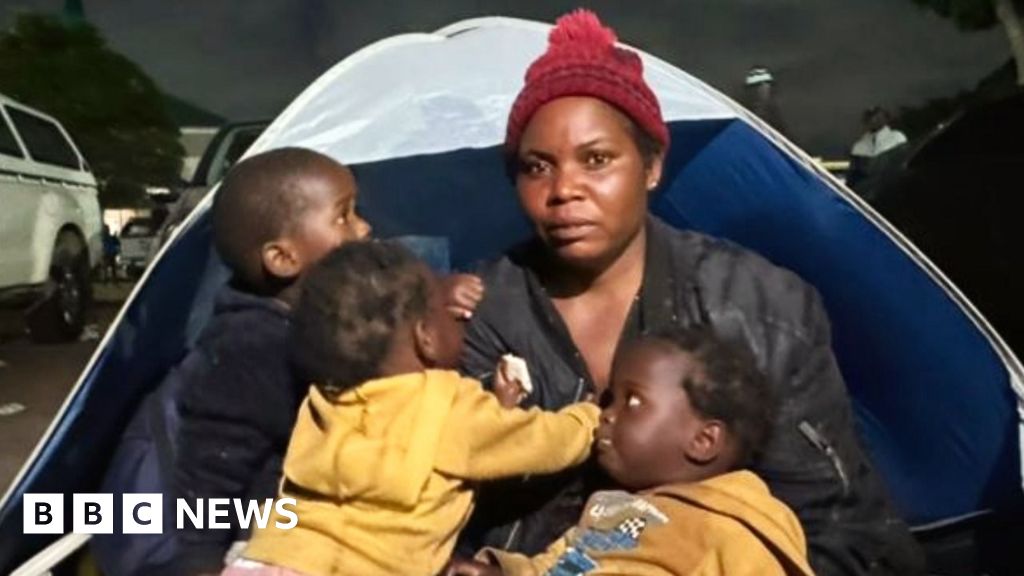
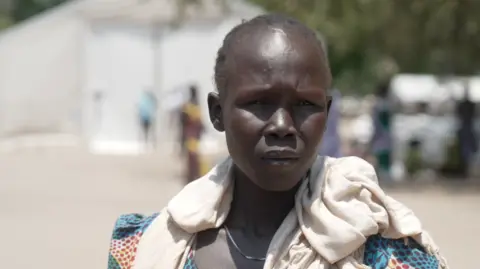
Mother-of-five Nyawan Koang was trapped between warring sides
Thousands of people have been fleeing the South Sudanese town of Akobo and surrounding parts of Jonglei state, where the army says it has intensified strikes on its enemies to regain control.
The latest fighting has led the UN to warn of a possible return to full-blown civil war in the world's youngest nation.
Nyawan Koang, 30, and her five children had to walk for two days to reach the dusty village of Duk.
They had fled Ayod, a remote and largely pastoralist county in Jonglei state, where armed clashes had been raging between the military and their opponents who had been fortifying their presence there since the beginning of the year.
"We were [wedged] between two forces: the SPLA-IO and the government. And their bullets kill us," she told the BBC.
Government forces are trying to retake territory from those loyal to First Vice-President Riek Machar, who has been suspended from his post after being accused of plotting to overthrow President Salva Kiir. Machar has been under house arrest in Juba for a year awaiting trial for murder, treason and crimes against humanity. He denies all charges.
Aligned with Machar are the Sudan People's Liberation Army in Opposition (SPLA-IO), who have been seizing towns in Jonglei and other neighbouring states.
As they advanced, threatening Jonglei's capital, Bor, they left devastated communities in their wake. Whole villages have been torched and civilians indiscriminately killed. The government has responded swiftly - and ferociously - deploying more troops to attack the positions of their rivals.
But civilians were also attacked - including Nyawan's family.
She lost both her parents when an air strike hit their small thatched-roof hut.
"Fire came from the sky and burned them," she said.
Nyawan and her family are among the more than 280,000 people forced from their homes by recent clashes. Thousands of them are in Duk, where aid organisations provide food, medicine and other basic essentials.
Yet more lives are likely to be turned upside-down, or snuffed out altogether, unless a political change of course is made.
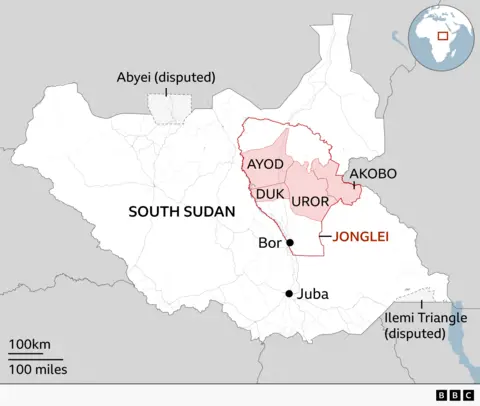
Fighting between forces loyal to President Salva Kiir and his rival-turned-deputy Riek Machar first broke out in 2013, just two years after the euphoria of independence.
A 2018 peace deal ended the civil war that had killed nearly 400,000 people, but it has never been properly implemented and the relationship between the pair has become increasingly strained amid ethnic tensions and sporadic violence.
It is not clear how many people - civilians or combatants - have been killed in the renewed conflict. One report by the UN's rights body documented 189 civilian deaths in January alone.
"Civilians are bearing the brunt of a spike in indiscriminate attacks including aerial bombardments, deliberate killings, abductions and conflict-related sexual violence," said the body's head Volker Türk.
Nyawan remembers seeing several dead bodies while she was fleeing to Duk. "But I don't know [which side] killed them."
As government forces and SPLA-IO fighters, who are supported by another armed group called the White Army, battle for control of territory, the lives of innocent civilians are being sacrificed.
"There's no army in the world that actually fought without civilians being caught in the crossfire," Information Minister Ateny Wek Ateny told the BBC in his office in the country's capital, Juba.
He says the army is "responsible" in its conduct, and adds that his government is "trying its best" and has "taken measures [to ensure] civilians are not involved in the situation". But he concludes "civilians who find themselves in the wrong place at the wrong time might be caught in the crossfire. There's no way you can prevent that."
Yet some of the attacks on civilians appear to be deliberate.
By the government's own admission, in the last week of February more than 20 civilians - including women and the elderly - were executed at close range in Ayod by government soldiers who took control of the area.
Army spokesman Maj Gen Lul Ruai Koang told the BBC that soldiers from two platoons and their commanders had been put in detention following internal investigations and now face a court martial.
In the government fallout that preceded this latest spike of violence, President Kiir not only fired Machar but also his wife - Interior Minister Angelina Teny - along with several other senior government figures.
The reason for Marchar's detention and trial are his alleged links to White Army fighters who seized control of a military base from the national army last year, say the authorities.
But Machar's supporters see the move politically motivated and in breach of South Sudan's power-sharing agreement.
Like many people seeking refuge and help in Duk, Hoth Wan Kornyom, a community leader and father of seven, has lost a relative in the violence.
His brother was killed in gunfire and his own house was set ablaze. While his fellow villagers in Uror county were fleeing the conflict, he recalls, some parents became separated from their children and it is not clear if they were ever reunited.
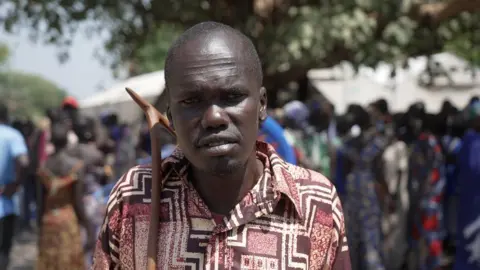
Hoth Wan Kornyom says parents and children were split apart in the chaos
Twenty-seven-year-old Neyasebit, who also left Uror for Duk, said her two uncles, a brother-in-law and a younger brother were killed in air strikes. "They were just staying at home," she explained, insisting they were not combatants.
"We suffered a lot. That's why we ran away," she told the BBC. "Both sides" are perpetrators of such attacks, according to her.
The resurgence of violence in Jonglei has exacerbated already dire humanitarian needs in the state. According to the World Food Programme (WFP), 60% of Jonglei's two million people are facing hunger. Across South Sudan as a whole, 10 million out of 14 million people need food aid.
"South Sudan is one of the world's most complex environments to provide humanitarian assistance," WFP's acting country director Adham Affandy told the BBC.
"We have conflict... natural disasters - and there are inter-communal violence, economic instability and the physical access challenges."
The country also has one of the least-developed road networks in the world, with only 400km (248 miles) of South Sudan's estimated 20,000km of roads being paved, according to a 2022 study.
During the rainy season - which can last up to eight months per year - around 80% of South Sudan is inaccessible, Mr Affandy said.
This has forced humanitarian groups to rely on aircraft to deliver assistance - at huge cost.
But the most pressing issue is insecurity. When clashes flared up in January, many relief agencies withdrew from conflict areas only to return once the violence had subsided.
Earlier this month, the army told aid agencies - and some 50,000 civilians - to leave Akobo county, one of the strongholds of SPLA-IO forces in Jonglei as it prepared to launch what it called a "second-phase" offensive.
Since its independence in 2011, South Sudan has struggled with several cycles of fighting.
It is also being affected by instability across the region. In the past three years, more than a million people have crossed its borders from its northern neighbour Sudan - where a devastating civil war is raging.
Now, many observers fear, the 2018 power-sharing agreement that brought relative calm could be shattered - something millions across the country dread.
"South Sudanese people are exhausted," WFP's Affandy told the BBC. "They want peace."
More BBC stories on South Sudan:
 Getty Images/BBC