 2 months ago
74
2 months ago
74
Tom SymondsNews correspondent, High Court

 Reuters
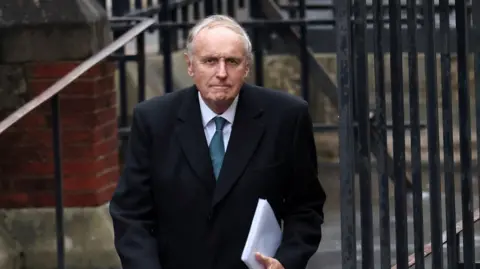
Former Daily Mail editor Paul Dacre has told the High Court he "brought the shutters down" on any unlawful newsgathering at the paper when he found out about it.
He was giving evidence in the privacy trial brought by seven people, including Prince Harry and Sir Elton John, who are suing Associated Newspapers Limited (ANL) - publisher of the Daily Mail and Mail on Sunday - for "grave breaches of privacy".
In court on Wednesday he accepted there may be evidence private investigators working on behalf of the paper may have used unlawful techniques.
Dacre was questioned on his response to an Information Commissioner's Office investigation into investigator Steve Whittamore, who admitted data protection breaches in 2005.
The investigation established that Associated Newspapers - the Mail's publisher - had made more use of Whittamore's services than any other newspaper group.
Dacre is the current editor-in-chief of DMG Media Ltd, the holding company of ANL.
Dacre previously defended the actions of Associated Newspapers at the Leveson Inquiry into press standards 14 years ago. There, he answered questions about the paper's use of private investigators to obtain information, and claimed there was no evidence of phone hacking.
At the Royal Courts of Justice on Wednesday, he denied lying during the 2012 inquiry when questioned by the claimants' barrister David Sherborne on stories alleged to have come from hacked phones.
Emails between freelance journalist Greg Miskiw and former Mail on Sunday associate editor, Chris Anderson in 2006, were one example shown to the court.
Miskiw, who has since passed away, had offered a story about a dispute between the actor Sadie Frost Law and her nanny.
His emails included transcripts of voicemails between them, which the court was told, had been made by the phone hacker Glenn Mulcaire, a close associate of Greg Miskiw.
In the end, the story was not published by the Mail on Sunday, but Miskiw asked for and was paid £500.
Sherborne said this was "prima facie" evidence of phone hacking, to which Dacre responded by saying it was only "evidence" Miskiw was "desperately trying to get work out" of the paper.
He added he did not know enough about the circumstances because he was editor of the Mail, not the Sunday newspaper, but suggested that the payment may have been a "kill fee" to prevent the story running in another newspaper.
The Mail on Sunday was a separate operation to the Daily Mail at the time, but both are published by Associated Newspapers.
As editor at the time, Dacre said the "realisation" that unlawful activities might have been going on "snuck up on us" and so he asked an executive at the paper to look into it.
He said that although it was difficult to fully investigate the extent of investigator Whittamore's use by Daily Mail journalists, he "brought the shutters down" to end the practice.
In 2007, Dacre banned his journalists from using "inquiry agents" - another term for private investigators.
"All my energy, all my willpower was going into educating my journalists, educating the industry that the Data Protection Act needed to be taken seriously," he said.
He admitted his journalists had used "inquiry agents" to get ex-directory numbers of people the Daily Mail was writing about, and from whom journalists needed to obtain a response.
"It's very low on the Richter scale of unlawfulness and there may be a public interest," he explained.
By using inquiry agents, journalists did not have to go to paper archives to look through phone books, the court heard.
Dacre rejected suggestions an experienced crime reporter on the Daily Mail, Stephen Wright, had paid private investigators for stories on the Stephen Lawrence murder investigation.
The court was shown handwritten payment requests submitted by the journalist totalling £1,500 for "special contacts" in relation to one story about the case.
Far from using unlawful techniques, Wright did "brilliant work" which helped bring two of the Lawrence killers to justice, he said.
Sherborne asked Dacre if the use of private investigators actually stopped following his ban in April 2007.
In a sometimes tetchy exchange, Sherborne put to the former editor that a series of journalists did not obey the ban and continued paying private investigators and freelance journalists for unlawful information.
One example quoted by the barrister, showed royal correspondent Rebecca English, receiving the precise aircraft seat number for Chelsy Davy, the then-girlfriend of Prince Harry.
Dacre said he was "totally unaware" of this, adding: "When I was a journalist, airlines were very relaxed about giving details."
It was not a problem for journalists to pay freelance reporters for information, he said, explaining that they were not inquiry agents.
"Every newspaper pays for stories," Dacre explained.
"They don't do it willingly. But news does not grow on trees, you have to secure it. As long as you don't pay a policeman it's ok."
The claimants' barrister, David Sherborne, who has led Prince Harry's series of legal challenges about press standards, has been repeatedly criticised by the judge in the case, Mr Justice Nicklin, for asking questions which went beyond the scope of the legal case.
On Tuesday, Sherborne was accused of trying to turn the trial into a public inquiry, and on Wednesday he was given a time limit for cross examining the former Daily Mail editor, who left the witness box shortly after 15:00 GMT.
The trial is due to conclude in March. A written judgment is expected to be issued at a later date.