 2 months ago
86
2 months ago
86
Ione WellsSouth America correspondent, reporting from Sucre, Venezuela
Watch: In Sucre, struggling Venezuelans are cautious about promised US oil investment
"This is the first gas delivery since December," a woman says, as crowds huddle around rusty canisters in the Venezuelan fishing town of Guaca, rushing to carry them home on their backs in the baking sun.
Venezuelans rely on propane gas for cooking and shortages of basics like this are common here in Sucre, one of the country's poorest states.
The state lies hundreds of kilometres east of Caracas. It feels remote from the talk of new foreign investment and oil deals circulating in the capital since the US seized Nicolás Maduro on 3 January, restoring ties with the interim government of Delcy Rodríguez.
Yet for ordinary people, the pressing question is whether the influx of foreign cash after Maduro's fall will reach them - and consequently also help stem migration and trafficking.

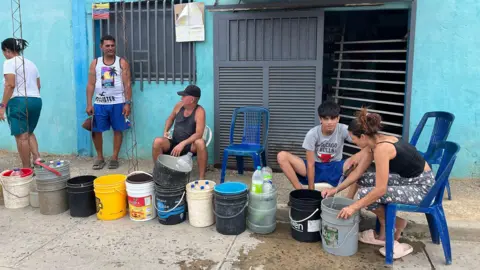
People in Cumaná have been queuing for water as well as for cooking gas
In Sucre's state capital, Cumaná, residents have been without running water for two weeks.
The state government, led by Maduro allies, blames a pipeline damaged in an earthquake last month but locals insist the water supply has been unreliable for far longer, as a result of years of underinvestment.
Some resort to collecting water from a rubbish-strewn stream.
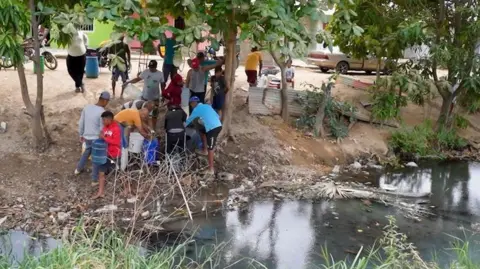
Without running water, some people collected water from a stream
Petrol is scarce too, with supplies squeezed by distribution problems and reduced refining capacity.
Vehicles queue for miles along highways, often for hours, for fuel that many in the world's most oil-rich country cannot afford.
Venezuelans who were once among the most prosperous in the region now feel poorer than counterparts doing the same work elsewhere in Latin America.
"In Ecuador, a family could catch 100kg of fish, earn $500 [£431], pay for fuel and still have money left over," says Pablo Marín, a fisherman in Guaca. "Here, you catch 100kg and you must catch another 100 to cover your expenses."
Fishing is the main occupation in Guaca, and fishermen like Marín are paid in the Venezuelan currency, bolivars. But inflation has eaten away at its value, leaving it near-worthless in the many businesses that price their goods in dollars.
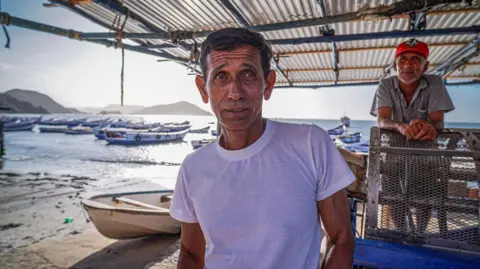
Pablo Marín says fuel is so expensive that little money is left over from the sale of the fish he catches
"Ten years ago, money had value, you could save. Now it's worth nothing," Marín explains, holding up a handful of bolivars.
Guaca is emblematic of the years of economic decline that, alongside corruption and repression, have driven millions out of Venezuela.
Fisherwoman Yurmari Martínez remembers a time, 20 years ago, when Sucre was a "place with potential". Back then, more companies processed and exported fish, creating competition that benefited fishermen, while other agricultural and manufacturing industries also thrived.
Fuel and raw material shortages, chronic underinvestment and nationalisations have hollowed out the local economy. That is why her 23-year-old son has dropped out of university: like many students, he is convinced that no qualification can lead anywhere.
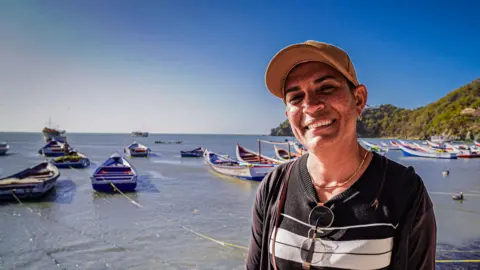
Yurmari Martínez says 20 years ago, Sucre was 'a place with potential'
"They feel that their dedication to their studies isn't worth it because of the situation in Venezuela," she says.
While there may not be many opportunities on land in Sucre, there is wealth off its shore. Oil giant Shell has long planned to develop a natural gas field located between Venezuela and Trinidad and Tobago.
US sanctions had delayed the project, known as "Dragon". But since Maduro's removal from office, Shell has been granted new licences. And following a visit by US Secretary of the Interior Doug Burgum earlier this month, the company signed a deal with the Venezuelan government to begin developing the field.
Although the gas will be processed in Trinidad and Tobago for export, Shell says the project will benefit Venezuelans as well.
Christopher Sabatini, senior fellow at Chatham House, a London think tank, says such projects may bring some jobs and a short-term injection of cash to local communities. But, he warns, they rarely generate wider development on their own, and longer-term benefits depend on whether governments reinvest the revenues effectively.
Otherwise, he says, "companies come in, extract the resources, oftentimes with foreign equipment and engineers, then ship it".
With the US now overseeing much of Venezuela's oil revenue in what Sabatini calls an "unprecedented" situation, how the funds will be used remains an open question. Even then, he adds, major investments in infrastructure, electricity and housing "can't be turned around simply in months".
Watch: Inside Venezuela's political transition two months after Maduro's ousting
Omar Zambrano, a Venezuelan professor and chief economist at the Anova policy research consultancy, points to evidence from the 1990s that poverty fell and education improved in areas that received oil investment when the industry was opened to private companies.
But after "25 years of degradation of the country's institutional, productive, and social fabric", he says, the conditions for that are now far less favourable. That period spans the rule of Hugo Chávez and his successor Maduro, during which mismanagement, corruption and sanctions took their toll.
The result is all too visible in Sucre. Three hours east of Guaca, along heavily potholed roads with no mobile signal and few basic amenities, the town of Güiria is a case study of the consequences of decades of neglect.
In the months leading up to the seizing of Maduro, President Donald Trump accused Venezuela of "flooding" the US with drugs. Maduro stands accused of conspiracy to traffic cocaine into the US and will appear in court in New York later on Thursday.
Since September, US forces have carried out dozens of strikes in the Caribbean and the Pacific targeting suspected drug boats, killing more than 160 people - and in Güiria, almost everyone knows one of them.
US officials described those on board as "narco-terrorists", but locals argue that their relatives were not members of cartels. Instead, they say that extreme poverty drove them to transport drugs on behalf of traffickers.
"People take the wrong path, out of necessity," says Diannys, a mother-of-five who says her husband was killed in a US strike in October.
Watch: Diannys, the widow of a fisherman killed in a US boat strike, describes 'difficult' impact on family
She doubts US strikes will stop people from tying to "get ahead, to survive" where there are no job opportunities.
"There are people who may have done it for the first time, risking their lives to give their family a better future. Of course, it's not right," she says.
The brother of another man killed, who wanted to remain anonymous, says he understands why people take the risk. Work here, he insists, "doesn't pay".
He says that his brother fished and planted crops, but travelled to Trinidad for better pay. He was then "recruited" by traffickers looking for fishermen who can "handle the sea".
"I heard they offered him $10,000. I earn $10 weekly, enough for three meals."