Feb 13, 2026, 02:21 PM ET
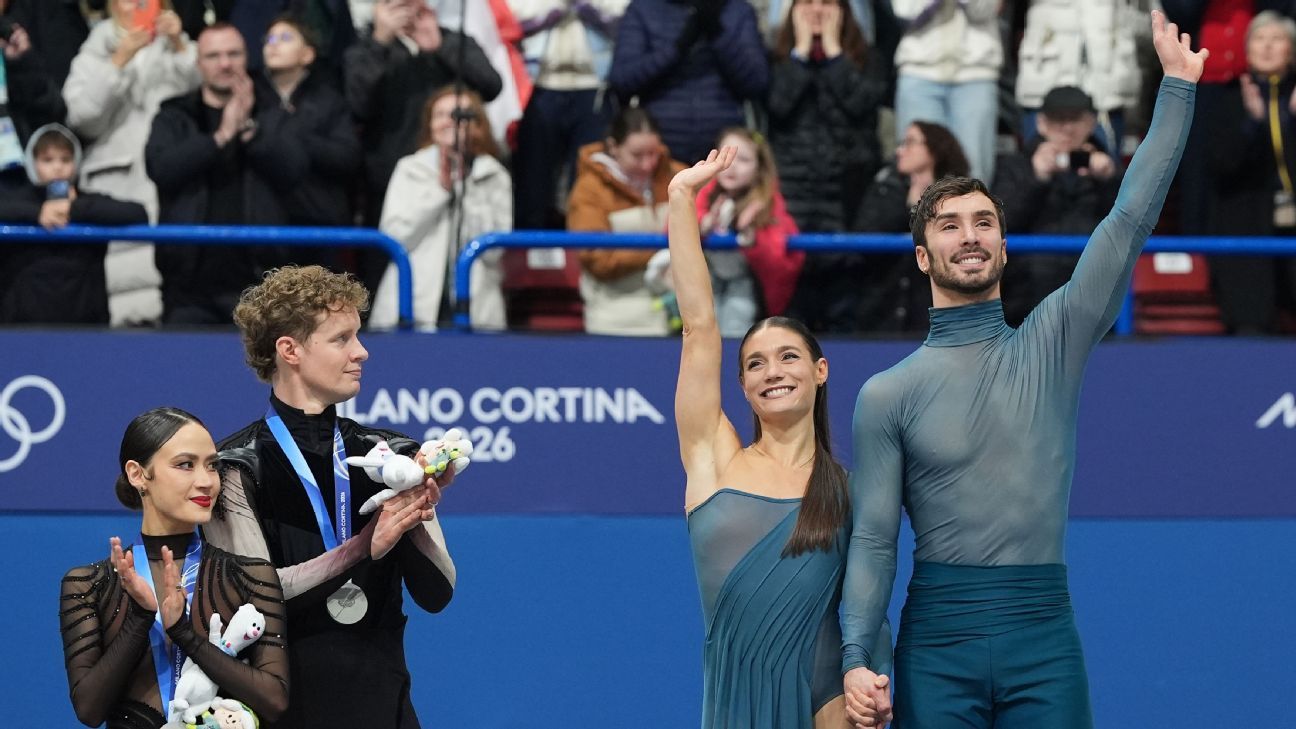
MILAN -- On Wednesday, France's Laurence Fournier Beaudry and Guillaume Cizeron won the Olympic gold medal in ice dance, narrowly edging out heavy favorites Madison Chock and Evan Bates of the United States -- and the turmoil over the outcome remains.
Both pairs recorded their season-best score in the free dance, but ultimately Fournier Beaudry and Cizeron edged out Chock and Bates by a margin of 1.43 points after both nights of competition. Chock and Bates, the three-time reigning world champions, were clearly disappointed after the scores were announced and were emotional throughout the podium ceremony and during their media obligations later in the evening. Bates called their program their "gold medal performance" and both said they were proud of what they had done on the ice.
While Chock and Bates have remained gracious when asked about the judging of the competition, the results have sparked backlash -- and conversations about inconsistencies and potential unfairness.
Here's everything to know about the judging discrepancies and other controversies around the French team.
Why do people believe the outcome was unfair?
After Fournier Beaudry and Cizeron earned the highest scores in the rhythm dance segment on Monday, despite some obvious synchronization issues on their twizzles and a clean skate from Chock and Bates, there was already debate about potential bias.
However, that went into hyperdrive after the free dance as Fournier Beaudry and Cizeron again had visible errors with their twizzles. Chock and Bates, on the other hand, had no such problems, and again had a near-flawless execution of their twizzles and all elements.
While several of the judges scores raised questions of bias and even nationalism, it was the French judge that really garnered notice. The judge, Jezabel Dabouis, scored Chock and Bates' free dance a 129.74 -- the lowest score from all nine of the judges on the panel and more than five points lower than the average. Dabouis gave Fournier Beaudry and Cizeron a 137.45, nearly three points higher than the average score from the panel.
The same judge raised eyebrows when judging both pairs at the Grand Prix Finals in December, and gave the Americans only a slight edge despite multiple errors and a fall from Fournier Beaudry and Cizeron.
While Dabouis' scoring was perhaps the most blatant and consequential, the Italian judge also drew ire for giving the top Italian pair Marco Fabbri and Charlene Guignard a questionable score despite an error. The Italian judge was the only one of the nine judges to place them in the top three.
Who has spoken out about it?
Chock and Bates have been measured in their reaction, but both have said multiple times they felt that they had skated at their highest level and did everything they could.
"I feel like life is ... sometimes you can feel like you do everything right and it doesn't go your way, and that's life and that's sport," Bates said on NBC after the competition. "And it's a subjective sport. It's a judged sport. But I think one fact that is indisputable is that we delivered our best, we skated our best, we did season's best almost every single time. And the rest is not up to us."
In an interview with CBS on Thursday, Chock added she believed judges should be "vetted."
"There's a lot on the line for the skaters when they're out there giving it their all, and we deserve to have the judges also giving us their all and for it to be a fair and even playing field," she said.
In another interview, she added such confusion about results "does a disservice to our sport."
Others have been even more outspoken about their feelings. Even Fabbri, who finished just off of the podium with Guignard, made his feelings clear atter the event.
"I usually prefer Laurence and Guillaume," Fabbri told reporters. "But tonight, Chock and Bates deserved [the gold medal]."
Guignard said she agreed. Fellow American ice dancer Emilea Zingas, who finished in fifth with her partner Vadym Kolesnik, expressed a similar sentiment when speaking to the media.
"I think they skated fabulously today," she said. "It's disappointing to me that they didn't get the gold, but they're my favorites. If it was my gold to give, I'd give it to them."
A fan petition has since been created on Change.org urging the International Skating Union to investigate. At the time of this writing it has over 15,000 signatures.
Simply BEAUTIFUL. This is what 15 years of skating together looks like. 😍 pic.twitter.com/UQhpVEBB90
— NBC Olympics & Paralympics (@NBCOlympics) February 11, 2026Has the ISU responded?
The ISU issued a statement on Friday defending the scoring.
"It is normal for there to be a range of scores given by different judges in any panel and a number of mechanisms are used to mitigate these variations," the ISU said.
The organization added it has "full confidence in the scores given and remains completely committed to fairness."
Who are Laurence Fournier Beaudry and Guillaume Cizeron?
The French pair at the center of it all are no strangers to controversy.
Fournier Beaudry had previously represented Canada with Nikolaj Sorensen, who is also her romantic partner, before he was suspended from the sport for six years following sexual assault allegations. She has publicly issued her support of him. The suspension was overturned in June on jurisdictional grounds, but the case remains pending.
Cizeron won Olympic gold in 2022 with his partner Gabriella Papadakis. She has since retired, as he did initially, and released a book this year calling him "controlling" and "demanding." Cizeron has said Papadakis' book and her allegations were a "smear campaign" and has denied the claims.
Fournier Beaudry and Cizeron announced they were teaming up last year -- to much scrutiny -- and are in their first season together. Fournier Beaudry received her French citizenship in November. The duo won two Grand Prix titles and the European Championships before coming to the Olympics -- an unusual run of success for such a new pairing.
They train at the Ice Academy of Montreal, alongside Chock and Bates. Both teams work with the same coaches: Marie-France Dubreuil, Patrice Lauzon and Romain Haguenauer. Chock said they were "blindsided" by Cizeron's return to the sport and the training facility, as well as the new partnership.
"They told us I think the day before they came to officially start training, and it was a lot to digest at first," Bates told NBC ahead of the Olympics.
Olympic gold for Laurence Fournier Beaudry and Guillaume Cizeron 🇫🇷 pic.twitter.com/fBHi3cjErQ
— Embassy of France in the U.S. (@franceintheus) February 12, 2026Have there been any other issues with judging in ice dance?
Yes. Piper Gilles and Paul Porrier, the two-time reigning world runners-up who earned the bronze medal Wednesday, have openly questioned scoring inconsistencies throughout the season.
Gilles criticized the technical panel at the Grand Prix event in Finland in November, and she later posted to social media about her frustration with the judging at the Grand Prix Final the following month. She wrote that many in the sport were being "diminished and manipulated by people with agendas," and tagged the International Skating Union.
Even Cizeron voiced his displeasure at the same Grand Prix event in Finland.
"Of course I'm angry," Cizeron said in a news conference. "I see some strange games being played that are destroying ice dance. I don't think I've ever been to a competition like this in my career, from a judging standpoint."
There have of course been other famous instances in figure skating overall. Perhaps the most known case also featured a French judge.
During the 2002 Olympics, Russian pair skaters Elena Berezhnaya and Anton Sikharulidze won the gold over Canada's Jamie Sale and David Pelletier. However, allegations of vote-swapping and selling against Marie-Reine Le Gougne, the French judge, quickly emerged and resulted in an investigation by the ISU. She was found guilty and suspended. Sale and Pelletier were ultimately elevated to the gold.