 3 months ago
82
3 months ago
82
Jonathan BealeDefence correspondent

 Reuters
Earlier this month, US President Donald Trump sent a message to Iranians protesting against the regime that "help is on its way".
Since then there has been a slow, steady and significant build-up of US military forces in the region.
America, which is the world's most powerful military, has already shown it can strike Iran. Last June's operation "Midnight Hammer" targeted its nuclear facilities.
That involved more than 100 aircraft, with B2 stealth jets flying all the way from the United States to deliver their "bunker-buster" precision guided bombs. All without a single loss.
The question now is: Is the US getting ready to hit Iran, again?
Donald Trump's latest post on social media suggests he may, with him warning Iran that unless it makes a deal to limit its nuclear programme then "the next attack will be far worse!".
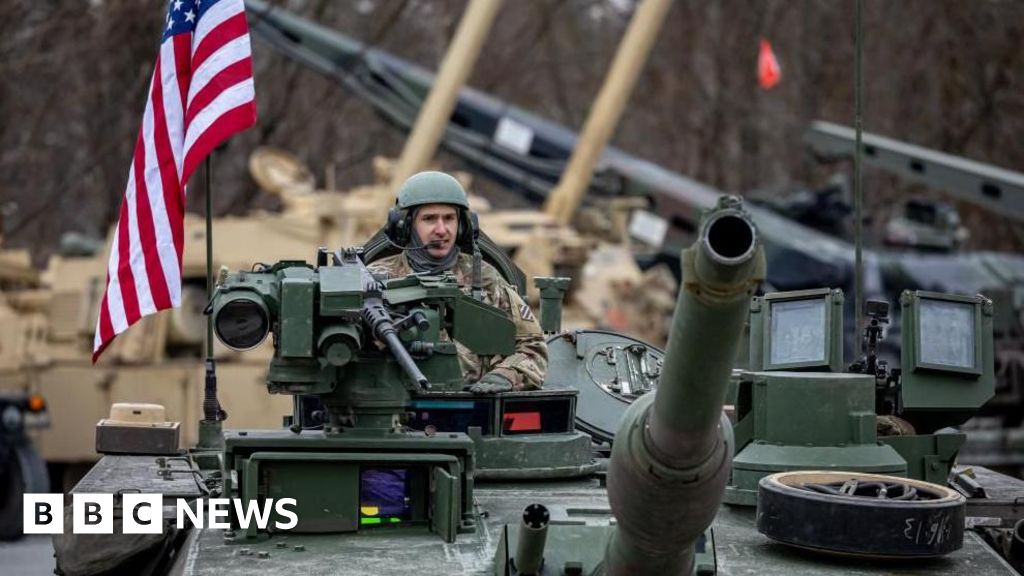
The US already has a significant military footprint in the Middle East, with up to 50,000 military personnel in the region.
Around 10,000 of those are based at al-Udeid Airbase in Qatar. But the US also has bases in Jordan, Saudi Arabia, the United Arab Emirates, Oman and Bahrain.
But over the past few weeks open source intelligence reporting has tracked scores of additional US military aircraft arriving in the region.
Photos taken of al-Udeid Air Force Base in Qatar- the largest American facility in the Middle East - on Sunday show a number of new structures appearing at a site on the periphery of the base.
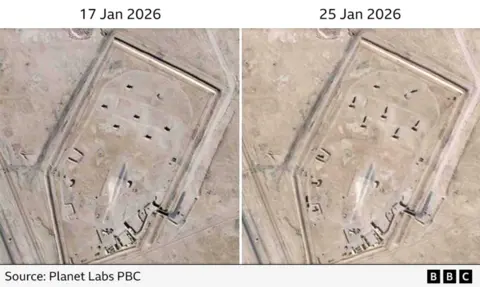
The Pentagon does not provide a detailed list of those movements. But sources on social media have tracked the arrival of F-15 fighter jets, refuelling tankers and transport aircraft.
Some of those transport aircraft are believed to have been carrying additional air defence systems, which may suggest that America is taking steps to defend itself and its Gulf allies from possible retaliatory strikes, if President Trump ordered an attack on Iran.
Britain, too, has sent a squadron of Typhoon jets to the region "to boost regional security".
The US Air Force has announced that it is conducting a major exercise in the region (Agile Spartan) "to demonstrate the ability to deploy, disperse, and sustain combat airpower across the US Central Command area of responsibility".
Stefan Watkins, who tracks ships and shares his findings on social media, has also recently tracked the arrival of a number of US early warning and "spy" aircraft which were in evidence during Operation Midnight Hammer – including RC-135s, and E-11A BACN and E-3G Sentry. He says that "might suggest" if strikes are "coming sooner rather than later".
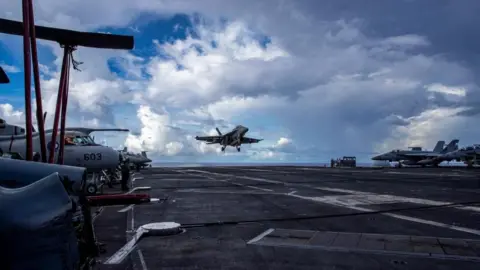
Just as significant is the arrival of a US carrier strike group to the region.
The USS Abraham Lincoln was in the Indo-Pacific region when it was ordered to turn around and head to the Gulf. A carrier strike group is one of the most potent symbols of American military power, with an air wing of around 70 aircraft.
On the USS Abraham Lincoln that includes the latest F35 stealth jets, capable of evading enemy radar. The strike group includes three destroyers loaded with Tomohawk land attack cruise missiles, and is normally accompanied by a nuclear powered submarine, which fires the same weapon.
That is in addition to the two US destroyers already in the region. In the words of President Trump: "We have a big flotilla going in that region and we'll see what happens".
Matthew Savill, director of military sciences at RUSI, says that with their current military posture in the region the US "could probably go almost anywhere in Iran and strike almost anything, apart from the most deeply buried facilities" – which would likely require B2 bombers.
So, what might the US target, if President Trump gives the order?
Savill, who worked on Iran policy in the UK government, says the US has a range of options.
The first could be Iran's military capabilities, "like its ballistic missile threat or its coastal missile batteries". At the very least that could make it harder for the regime to retaliate, which it is threatening to do.
Iran still has significant stockpiles of short range ballistic missiles and long range drones. That makes some of America's Gulf allies nervous. A number have already made clear they will not support more US strikes.
Another option would be to target the regime itself.
Savill says "they could go after the centres of military power, including Iran's Revolutionary Guard Corps and maybe the militias that are suppressing the protesters".
Trying to decapitate Iran's leadership, though, may prove more difficult and dangerous.
Israel did target senior Iranians during its 12-day war last year. That included tracking bodyguards to find their locations. But Iran is likely to have since tightened up security and dispersed.
Savill says the US "could probably find and kill senior individuals, but it is not clear what the cumulative effect would be".
"We could be witnessing the final death throws of this current regime, but the problem is that could take months or even years to play out," Savill adds.
While President Trump has proved that he is willing to use military force, he has made clear in the past that he has no desire to get involved in a long protracted conflict.
His military interventions so far have been short, sharp and limited.
He has also not ruled out a diplomatic solution that would require Iran to agree to limit its nuclear programme.
According to Savill, Trump is now having to "weigh the desire to be seen as decisive with the chances of actually achieving a decisive impact".