 3 months ago
122
3 months ago
122
3 hours ago
Wyre DaviesBBC Wales Investigates

 NCA
NCA
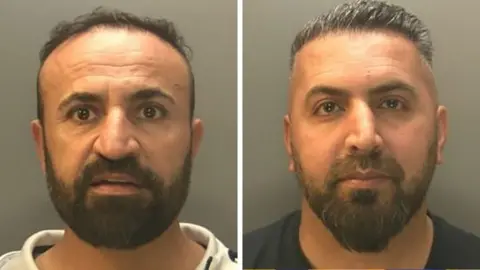
Dilshad Shamo and Ali Khdir ran the huge people smuggling operation from their car wash business in Caerphilly
Two men who ran a huge people-smuggling operation from a car wash have been sentenced to 19 years each in prison.
Dilshad Shamo, 41, and Ali Khdir, 40, organised the smuggling of about 100 migrants to Europe weekly for two years, labelled a "Tripadvisor for people smugglers" by the National Crime Agency.
They worked from an otherwise legitimate car wash business in Caerphilly, south Wales, and financed the scheme using a Middle Eastern money-transfer system called Hawala banking.
After previously pleading guilty partway through a trial, they appeared at Cardiff Crown Court for sentencing, with a judge describing them as "having leading roles in a sophisticated and successful" operation.
Shamo and Khdir were both originally from Iraqi Kurdistan but were living and working legally in the UK.
After they came to the attention of the National Crime Agency (NCA), undercover investigators and surveillance officers gathered hundreds of hours of evidence based largely around their carwash business.
An NCA spokesperson said Shamo and Khdir were part of "a larger organised crime group" and were "facilitating the movement of migrants from Iraq, Iran and Syria through Belarus, Moldova and Bosnia and ending in Italy, Croatia, Romania, Bulgaria, Slovenia, Germany and France".
They offered a multi-tier service to potential migrants with varying levels of "service" and transport along the route to Europe, depending on the price paid.
Migrants were encouraged to rate their journeys in videos filmed inside lorries or boats or via social media channels including Telegram and TikTok.
"How was the route, guys?" a man asked in one clip, as someone at the back of the lorry gave a thumbs-up.
"God bless you, we are very grateful," said one Iranian family who were smuggled to Europe, as they posed outside an airport.
 National Crime Agency
Khdir at the car wash in Caerphilly, from where the smuggling operation was run
In one video, a migrant said: "Lorry route agreed with knowledge of the driver; here we have men, women and children - thank God the route was easy and good."
Another showed men smiling to the camera as they pointed to at least a dozen other migrants travelling on a boat.
Derek Evans, NCA branch commander, said Shamo and Khdir operated "like a travel agency".
"It's like Tripadvisor, they were rating their service within that community," he said.
The highest tier offered - platinum - would get migrants a fake passport and air travel, costing between £10,000 and £25,000. The gold tier would be by ship, costing between £8,000 and £10,000, while bronze, the most basic service - between £3,000 and £5,000 - would involve travel in a heavy goods vehicle or dinghy across the Channel.
According to the NCA, most of the people using the services were searching for a better life in western Europe. Many are believed to have come to the UK.
NCA investigators estimated the pair may have smuggled thousands of people into and across Europe over two years, making huge profits in the process.
Evans said: "Our long-running investigation showed Khdir and Shamo were working around the clock to orchestrate the movement of migrants across Europe. We believe they smuggled more than 400 people in a period of just six months."
But, partly because of the largely anonymous and untraceable way in which the business was financed, very little of their profits have been recovered, even though they could have made hundreds of thousands - if not millions - of pounds.
"The tangible assets in the UK are minimal," said Evans.
"Most of the money was never actually received by Shamo or Khdir – it was all done in Iraq through the Hawala system.
"So, most of that money is still in Iraq or Kurdistan."
In Hawala banking, no cash is physically or electronically moved, making it difficult for police to recover proceeds of crimes.
In the case of people smuggling, those wishing to make the journey, or their relatives, make a payment with a broker in Iraq. At every stage of that journey, smugglers or facilitators will take their share of the fee from other brokers across Europe, having been provided with a code specific to that particular transaction.
There are several legitimate reasons for using Hawala banking, in particular for people without bank accounts wanting to send money abroad.
But HM Revenue and Customs (HMRC) says the ease of moving money through Hawala and other types of Informal Value Transfer System (IVTS) makes them very attractive to criminals.
It urged operators to register for HMRC anti-money laundering supervision.
"Legitimate businesses play a critical role in preventing money laundering. Supervised businesses need to stay alert to suspicious activity and put systems in place to protect themselves from exploitation," a spokesperson said.
 NCA
NCA
"God bless you, we are very grateful," said one Iranian family smuggled to Europe
Like Shamo and Khdir, Gheshlaghian used an otherwise legitimate business – in his case, a rug company – as cover for the much more lucrative trade of money laundering for people smugglers, from which he and his associates made millions.
BBC Wales Investigates travelled to northern Iraq, from where many of the people Shamo and Khdir arranged to smuggle through Europe started their journeys.
In the vibrant city of Erbil, in the semi-autonomous region of Iraqi Kurdistan, we were told several smuggling gangs operated in the region's hugely profitable smuggling business.
Through a local contact, it was easy to find adverts on several social media platforms offering transport to western Europe for a fee.
Using an undercover journalist, posing as an Iraqi man looking to reach the UK, we spoke to one smuggler who said he could arrange for us to be taken from France to the UK in the back of a lorry for $5,000 (£3,900).
Another man, who called himself Bawar, claimed to be based in Cardiff and offered a more expensive, but less dangerous, trip with a fake passport.
"The amount is $8,000 (£6,200) and you can easily deposit the amount in any transfer office you want," he told us.
Migrants heading to Europe are asked to rate their journeys in videos filmed by smugglers
When our undercover reporter arrived at the Hawaladar in Erbil, the man running it appeared to be familiar with the arrangements. We confirmed we were travelling with fake documents provided by Bawar.
His fee for his role in the operation was £400. Others along the route would take their share, depending on the complexity and risk of the service provided.
We did not go through with the deal, but it illustrated how easily and regularly the hawala banking system was being exploited by smugglers.
When the BBC later approached Bawar for comment, he denied being involved in smuggling, claiming he was an impoverished shepherd.
The Hawaladar owner in Erbil denied offering to take money to help our undercover reporter travel to the UK on a false passport.
Sentencing Shamo and Khdir to 19 years each, of which they will serve 40% in custody, Judge Tracey Lloyd-Clarke said it was "sophisticated offending".
"You acted primarily for financial gain. I am satisfied that the harm caused was high as you facilitated the smuggling of a very large number of individuals."
The judge said the offending was aggravated by the fact it was sustained, involved actively recruiting others, and "some of the routes involved dangerous situations such as migrants hiding in a lorry overnight on a ship or crossing a border protected by razor wire and guards".
But she added the pair "provided the best service that you could to the migrants, checking the viability and safety of the routes and showing some concern for their well-being".
"Importantly, there was no exploitation of the migrants."
While the NCA and HMRC are stepping up their efforts to combat the role of informal financial systems, including Hawala banking, in financing organised crime like people smuggling, they can be very difficult systems to understand or penetrate.
Social media platforms also told us they had zero tolerance for any content that promoted people smuggling and were working with authorities to combat organised crime.
But, following the sentencing of Shamo and Khdir on Friday, Evans acknowledged that "because of the profits that can be made, it is almost inevitable that somebody will look to fill the gap".