 2 months ago
94
2 months ago
94
Simon Jones,in Canterburyand Patrick Barlow,South East

 Reuters
More than 10,000 meningitis B vaccines have now been administered following an outbreak in Kent, according to the UK Health and Security Agency
Meningitis B vaccinations will be extended to Year 11 pupils at schools in Kent where older students have already received them, UK health chiefs have said.
Vaccinations in the county will be widened out to 15 and 16-year-olds at four schools as a precautionary measure to "ensure longer-term protection", the UK Health and Security Agency (UKHSA) said.
The UKHSA says the number of confirmed cases remains at 20, while three cases remain under investigation, dropping the total to 23 from the 29 reported on Sunday. Four people remain in intensive care.
Over 13,300 doses of antibiotics have also been administered, it added.
Meningitis vaccines for the Year 11 pupils will be delivered in the four schools affected.
Pupils are being asked to wait for further details rather than head to vaccination clinics.
'Existing treatments effective'
A report released by the UKHSA on Tuesday said the earliest known meningitis case linked to the outbreak was on 9 March, and the latest on 16 March.
The peak of the outbreak was on 13 March, and four people who contracted meningitis B remained in intensive care as of Monday, according to the report.
All of the cases in the outbreak were young people with an average age of 19, the UKHSA report added.
 Simon Jones / BBC
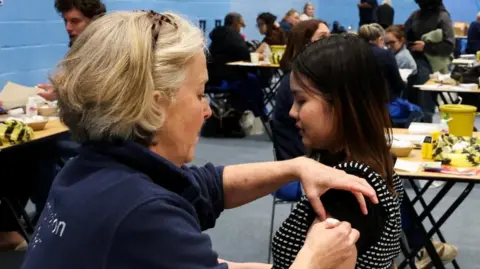
Students queuing for the meningitis B vaccine in Canterbury on Tuesday
On Tuesday, students queuing for vaccines said the Canterbury campus remained "like a ghost town" over fears linked to the outbreak.
Chloe Bower, a university student, said: "My mum had meningitis when she was younger so for us it's important for me to get the vaccine."
Ella King says: "It's like a ghost town in Canterbury. We have only been back a day, but we haven't been into town and are reluctant to go into coffee shops."
Tushar Jhanwar, who works at the university, said: "It's important for me to get the vaccine just to be safe.
"People have been scared, but there has been great support."
Prof Robin May, chief scientific officer at the UKHSA, says its analysis offers "strong reassurance that our existing vaccinations and antibiotic treatment offer will be effective against this strain".
The number of confirmed cases previously dropped on Sunday, from 23 to 20, while the number of probable cases also fell from 11 to nine.
The UKHSA report said a number of factors could be contributing to the outbreak, including differences in the strain, levels of immunity and social and environmental factors.