 1 month ago
80
1 month ago
80
3 hours ago
Roger Johnson,Presenter, BBC North West Tonight, Sallie Georgeand William Higgens,North East & Cumbria Investigations

 BBC
BBC
Steve Hindley says it has become his life's mission to uncover the truth about St Monica's Maternity Home
Sick babies – who were considered unsuitable for adoption – were allowed to die at a church-run mother and baby home in Cumbria, according to a new study of documents by a leading academic. The findings have been welcomed by one man who has fought for years to uncover the truth of what happened there.
Warning: This story contains distressing details
"She genuinely thought she was a wicked person. She thought she was worthless, and that's how she spent the rest of her life."
Steve Hindley's wife Judith struggled to talk about what happened to her as a teenager when she was sent, pregnant and terrified, to a home for unmarried mothers in Kendal, Cumbria.
Judith said she had become pregnant after being raped. She was one of tens of thousands of young girls and women sent away to have their babies, hidden from society due to the shame of their unmarried status. Many had their babies forcibly adopted.
Judith's son Stephen was born with spina bifida and hydrocephalus at St Monica's Maternity Home in January 1964. Despite her pleading for medical attention, he died 11 weeks later, having been denied hospital treatment.
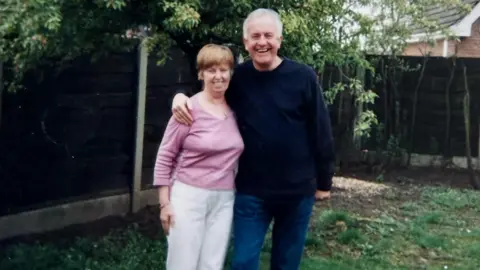 Stephen Hindley
Steve Hindley is determined to get justice for Judith and Stephen
One of the country's leading experts in homes for unmarried mothers has spent months piecing together surviving records about St Monica's, which was run by the Church of England.
Dr Michael Lambert, a lecturer in medical humanities at Lancaster University, studied hundreds of national and regional archive documents to build a picture of how and why Stephen Holt - and other infants - died.
The conclusion of his 80-page report found Judith's baby was left to die because his disability made him an unattractive proposition for adoption.
"It is clear that according to the standards of the day, he was denied access to modern medical care because his mother was unmarried, he was illegitimate, and his short life was contained in an institution whose culture was centred on secrecy and providing desirable children for adoption," Lambert's report says.
"In short, in such a context, because Stephen was born with a disability, he was left or enabled to die in what were deemed his best interests given the range of alternatives by those tasked with his care."
The research - now handed to Cumbria Police - concluded other babies were also allowed to die at the home because they were unadoptable.
"The infants that aren't being cared for where the deaths are taking place are disproportionately those that aren't desirable for adoption," it finds.
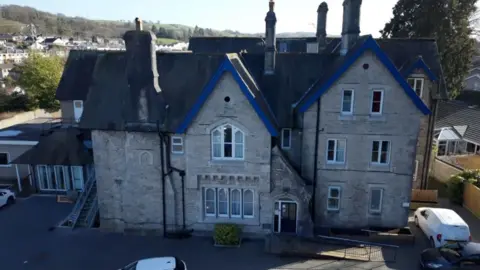
St Monica's closed in 1970 and the building is now run as an unconnected care home
After Stephen's death, Judith vowed to become a nurse and devoted her life to the care of sick and terminally ill children.
But she never overcame the trauma and took her own life in 2006, close to where her son had been buried in an unmarked grave at Kendal's cemetery alongside other babies who died at the home.
"When she died I said to her, 'now love, you made me not investigate all these years and I kept my word, " Steve says.
"You've passed now love, the baton's in my hands. And I'm going to do whatever it takes until the day I die to get this dealt with and to get some justice'."
For Steve, the findings are vindication after decades spent trying to reach the truth.
"I think the baby was murdered. I think he was deliberately terminated," he says.
"This is criminal neglect from the authorities who could have done something."
Annual reports seen by BBC North East and Cumbria Investigations show at least 400 babies were adopted from St Monica's, which operated from 1918 until its closure in 1970.
The BBC has also seen death certificates of more than 50 babies who died at the home between 1933 and 1967.
More than 40 of the deaths took place during the tenure of the home's long-serving matron, Elsie Stannard, who ran it for 27 years and was described by Lambert as "incompetent and fixated on petty cruelty".
The death records show a number of babies died from treatable conditions, while others died from massive head injuries believed to be suffered during childbirth.
The home was run by the Diocese of Carlisle and funded by grants from local authorities who sent women there from across the north-west of England.
The diocese welcomed the report and thanked Lambert for his work.
It said it continued to offer "heartfelt apologies" to those affected by malpractice at the home and said it was committed to full transparency in support of any police investigation.
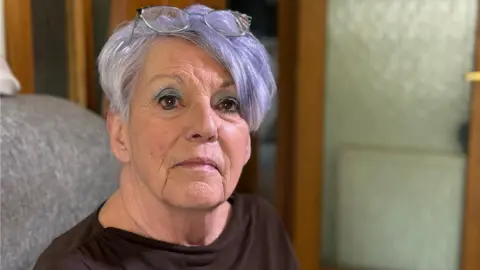
Jan Lawden spent decades searching for her baby son Julian, who was adopted in 1968
Jan Lawden was 15 when she was sent to St Monica's with her newborn baby Julian in April 1968.
"It was scary", she says. "I remember being on my hands and knees polishing, scrubbing stairs.
"It was a bit like being in prison."
Jan, now 73, remembers vividly the day she had to give up her baby for adoption and spent years trying to find out what happened to him.
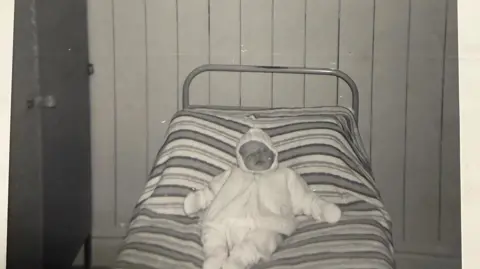 Jan Lawden
This is one of only two photographs Jan has of her baby son Julian
"We couldn't get any information from anybody", she said.
In 2025 after decades of searching, she was told Julian had died in his late 20s.
"It was worse than not knowing. I'd like someone to tell me what kind of life he had.
"And I'd like to know where he is, to put a kind of closure on it, that would help enormously."
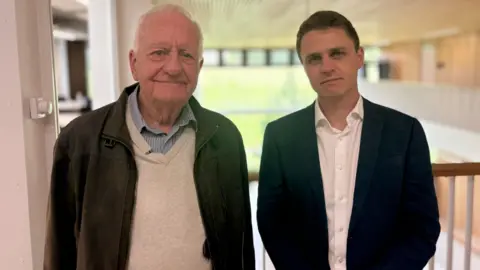
Dr Michael Lambert has spent the past year compiling evidence at the request of Cumbria Police
Access to records has also been challenging for Steve and Lambert.
Both welcomed the approach by the Diocese of Carlisle, which previously apologised for Judith's treatment at St Monica's and opened its archives for investigation.
But Lambert is still restricted from accessing key documents held by other agencies which he believes could provide further key evidence about Judith's case.
The Church of England said in January it was planning to apologise for its role in the forced adoption scandal.
There have been repeated calls on the UK government to issue an apology for the state's role in forced adoption.
In a statement, the Diocese of Carlisle said it recognised the bravery of Steve Hindley and his "vital work in ensuring victims' and survivors' voices are not lost".
It said "each child and mother at St Monica's deserved the utmost care" and added "cruel or incompetent practices should have been prevented".
"Any behaviour which countered this was reprehensible," it concluded.
Steve, who has recently turned 80, feels he has achieved what he set out to do.
"I feel a sense of massive relief because I've been banging my head against a brick wall for decades", he says.
"I'm feeling I've fulfilled my mission, and I'm beginning to relax. Because I know Judy, if she's looking down now, will know that she wasn't worthless, she wasn't wicked.
"I believe she's had justice delivered and people now know what happened to her."
- If you have been affected by any of the issues raised in this story, information and support can be found at the BBC's Action Line.