 2 months ago
107
2 months ago
107
48 minutes ago
Peter HoskinsBusiness reporter

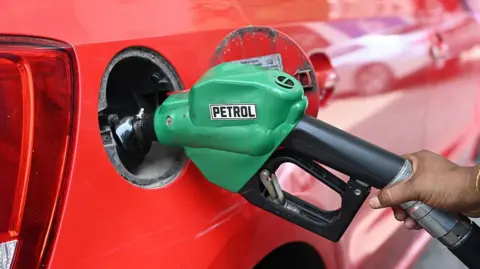 Hindustan Times via Getty Images
Oil prices have fallen sharply and Asian stock markets have risen on hopes of a deal that could bring an end to the US-Israel war with Iran.
US Secretary of State Marco Rubio said during a visit to India that negotiators had a "pretty solid thing on the table" and an agreement to end the conflict might be reached on Monday.
On Monday morning, global oil benchmark Brent fell 5.5% to $97.90 (£72.64) a barrel, while US-traded crude was 5.9% lower at $90.93.
US President Donald Trump had previously said the deal would include the reopening of the key Strait of Hormuz shipping route, without giving further details.
Iran said the US and Iranian positions had been converging in the last week.
The narrow waterway, through which around a fifth of the world's oil and liquefied natural gas (LNG) usually passes, has been effectively closed since the conflict started on 28 February.
"We're still a work in progress. As I said, you know, we thought we might have some news last night. Maybe today," Rubio said in the Indian capital, Delhi.
His comments came after Trump said he had instructed negotiators "not to rush into a deal", after earlier suggesting one was close.
Trump said on social media on Saturday that he had had a "very good call" with the leaders of Saudi Arabia, the United Arab Emirates, Qatar and others about a "Memorandum of Understanding pertaining to PEACE".
"An agreement has been largely negotiated, subject to finalisation between the United States of America, the Islamic Republic of Iran, and the various other Countries, as listed," Trump added.
"Final aspects and details of the deal are currently being discussed, and will be announced shortly."
He also said he had had a call on Saturday with Israeli Prime Minister Benjamin Netanyahu, which had gone "very well".
The president did not give any further details on the deal, but has insisted any agreement would "absolutely" prevent Iran from obtaining a nuclear weapon.
But on Sunday, he said on Truth Social: "Both sides must take their time and get it right. There can be no mistakes!"
Iranian foreign ministry spokesman Esmaeil Baqaei earlier told state television that US and Iranian positions had been converging in the last week, but warned that did not mean agreements would be reached on key issues and accused the Americans of "contradictory statements".
Global energy markets have seen big price swings since early March after Iran threatened to attack ships trying to use the Strait of Hormuz in retaliation for US and Israeli attacks on the country.
While crude oil prices have fallen sharply, they remain significantly higher than before the war. In the lead-up to the conflict Brent was trading at around $70 a barrel.
A ceasefire was agreed in early April, and since then Washington and Tehran have engaged in talks over a long-term peace deal.
"There is now some light at the end of the tunnel, which will bring some near term oil price relief," Saul Kavonic, head of energy research at MST Financial.
"But even in the most optimistic scenario from here, oil markets will remain tight through 2027 given the time required to normalise oil flows through the Strait, repair damaged oil facilities, and rebuild global oil stocks that have seen record depletion since the war began," he added.
Lars Jensen, chief executive of Vespucci Maritime and former Maersk director, said that even if a deal was announced on Monday the shipping industry would remain "very cautious and hesitant".
"You are likely going to see shipping lines that have vessels stuck in the Persian Gulf try to get them out, but they will be a lot more hesitant to put ships back into the Persian Gulf in case the thing turns south again," he told BBC Radio 4's Today programme.
Jensen pointed out that with issues such as potential sea mines in the strait and its surrounds, in a best-case scenario it would be months before supply chains were back to the way they had been before the war.
On Monday, the Nikkei 225 stock index in Japan rose above 65,000 for the first time after gaining 3% on hopes that the strait would soon reopen.
Japan, like nearby South Korea, has been particularly affected by the conflict as they are heavily reliant on energy from the Gulf.
UK and US energy and financial markets are closed on Monday for public holidays.