 2 months ago
98
2 months ago
98

 EPA/Shutterstock
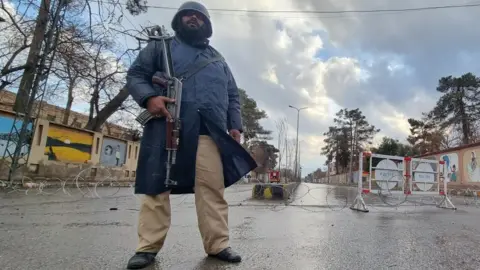
Some roads in Balochistan's provincial capital Quetta have been sealed off
Pakistan' military says it has killed at least 92 militants blamed for deadly co-ordinated attacks in the south-western Balochistan province on Saturday.
The military said 15 security service personnel and 18 civilians were also killed. It accused India of supporting the militants. Delhi has repeatedly denied such accusations.
The Balochistan Liberation Army (BLA) rebel group had earlier claimed responsibility for the attacks, saying dozens of soldiers were killed.
The claims by both sides have not been independently verified. The escalation is one of the deadliest days of violence in the impoverished province, where Pakistan's government has been battling an ethnic insurgency for decades.
In a statement late on Saturday, Pakistan's military blamed the militants for carrying out multiple attacks targeting civilians around the provincial capital Quetta and other cities.
The military said it responded by launching "clearance" operations across Balochistan and "successfully thwarted the evil design" of the rebels.
Some key administrative buildings in Quetta and roads around them were reported to have been sealed off during the day. Mobile phone services were jammed, and regional train services were suspended as a precaution.
Prime Minister Prime Minister Shehbaz Sharif later praised the military, pledging to "continue the war against terrorism until its complete eradication".
Earlier on Saturday, militants armed with grenades and guns attacked 12 cities and towns across the province, targeting police and paramilitary installations, as well as prison and government buildings.
The BLA accuses the federal government of exploiting rich mineral resources of Pakistan's largest province without benefiting the local population.
Local activists also blame Pakistani security forces for enforced disappearances - Islamabad denies the allegations.
Resistance against the Pakistani government and the militant insurgency advocating for an independent state for the Baloch people began in 1948, after Pakistan's independence from the British Indian Empire.
Sharing a volatile border with Iran and Taliban-controlled Afghanistan, Balochistan also boasts a vast coastline along the Arabian Sea.
The region derives its name from the Baloch tribe, which has resided here for centuries. Balochs remain the largest ethnic group, followed by the Pashtuns.
The largest part of Balochistan is in south-western Pakistan. The Pakistani province covers nearly 44% of the country's total land but is home to about 5% of the country's more than 240 million people. Balochistan is also the richest Pakistani province in terms of natural resources, including gas and minerals.