 3 months ago
96
3 months ago
96
Daniel WainwrightData journalist, BBC Verify

 PA Media
The number of planning applications for new homes in England is at its highest level for four years, new data shared with BBC Verify suggests.
Applications for 335,000 homes outside London were lodged in 2025, up by 60% on 2024, according to Planning Portal, the service people use to request permission.
But there are warnings that more needs to be done to meet Labour's target of building 1.5 million homes by 2029, as separate government data released on Thursday suggests there has been a decrease in house building.
The Ministry of Housing, Communities and Local Government said it had "overhauled the planning system and removed long-standing barriers that have held back housebuilding".
The increase in planning applications for new homes in England follows controversial reforms introduced by Labour, which allow development on some lower-quality green belt land, known as "grey belt".
According to Planning Portal data, between October and December 2025, 109,000 new homes outside London were applied for across England, up 61% on the same three months of 2024.
The figures only relate to England as housing matters are devolved elsewhere across the UK.
Every region except London saw a rise in the number of homes applied for in 2025, but in the capital they fell by almost a third on the year before, returning to levels similar to 2023.
While it's too early to know the impact, it should be noted that in October, the government gave the mayor of London powers to fast-track housing.
Geoff Keal from TerraQuest, which runs Planning Portal, attributed the overall growth across England to a "streamlining" of the planning process.
He also praised the "grey belt" reforms which had led to "applications coming through that wouldn't have previously".
But the Local Government Association - which represents local authorities - said while councils supported moves to tackle the housing crisis, planning reform alone would not deliver the scale of homes required to meet Labour's 1.5 million homes target.
It said delivery was constrained by a shortage of construction workers and rising building costs.
Other new data released on Thursday suggests the government has more work to do.
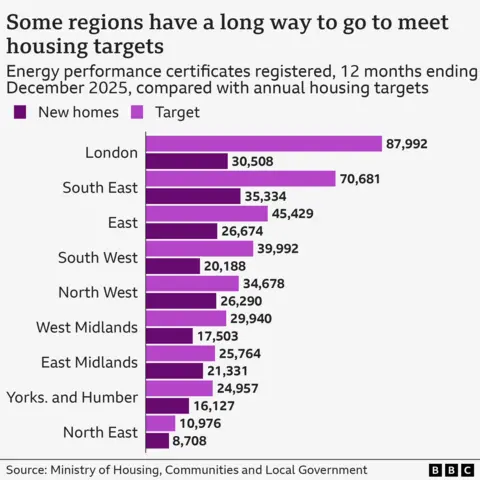
New figures released about Energy Performance Certificates (EPCs) - which measure how energy efficient a property is - in England in 2025 indicate that the total number of homes registered was slightly lower than the year before.
The government uses EPCs as an early indicator of new housing, because the data is published more frequently than the annual official new housing statistics. EPCs can also include homes that are not yet complete or occupied.
BBC Verify analysis of the EPC data suggests 99 areas out of 294 in England would need to more than double the number of new homes they had in 2025 to meet their annual target this year.
A further 22 saw the same number of homes or more registered than their targets called for, however councils said they expect the numbers to rise and fall from year to year.
There are however nuances to the data. For instance, 106,700 new homes in England received their first EPCs in the second half of 2025, which is 3,800 more than during the same six months of 2024.
In addition, the final three months of the year saw registrations rise by seven per cent compared with the same period in 2024.
In a report accompanying the EPC statistics, the government pointed to the Office for Budget Responsibility forecast of a continued decrease in completed homes because of "recent subdued housing starts".
Edward Clarke from planning consultants Lichfields said no-one should expect an upturn in housing yet as it can take years to go from planning to delivery.
"If the government's positive changes are implemented efficiently and effectively, there is an opportunity to achieve 300,000 homes built in a year by the end of this parliamentary term," he said.
A spokesperson for the Ministry of Housing, Communities and Local Government said: "Today's figures show we're not only delivering more homes, but they are built to a higher standard.
"We have overhauled the planning system and removed long-standing barriers that have held back housebuilding in this country.
"The impact of these reforms will continue to feed through as we accelerate towards 1.5 million homes."