
Bill ConnellyDec 18, 2025, 07:00 AM ET
- Bill Connelly is a writer for ESPN. He covers college football, soccer and tennis. He has been at ESPN since 2019.
South Bend, State College, Austin and Columbus set the bar high last season. Now it's time to shine the spotlight on Norman, College Station, Oxford and Eugene.
The first round of last year's inaugural 12-team College Football Playoff was memorable primarily for the otherworldly atmospheres -- and, consequently, home-field advantages -- it produced. Notre Dame Stadium levitated as Jeremiyah Love raced 98 yards for an early touchdown against Indiana. SMU's Kevin Jennings had to call timeout because he couldn't hear at Penn State's Beaver Stadium, then the crowd got even louder and he threw a pick-six. The four home teams were favored by an average of 8.8 points but won by an average of 19.3.
The second-ever first round gives us four more celebrated home crowds to put on display. Granted, close games are even better advertisements for the sport, but we might get a couple of those this time around, too. Let's see what script the sport writes this time around.
CFP projections
We head into the CFP with two clear favorites, a spicy No. 3 and a few others with a puncher's chance at the title. Here are the projections, per SP+:
(Note: These title odds are slightly different than what I posted after the CFP draw because of some slight changes I made to the win probability model.)
The first round gives us two projected tight games and two underdog upset bids. While coaching changes have been a big theme in the run-up -- Ole Miss' Lane Kiffin (LSU), Tulane's Jon Sumrall (Florida) and James Madison's Bob Chesney (UCLA) have all taken other jobs, as have Oregon offensive coordinator Will Stein (Kentucky head coach), defensive coordinator Tosh Lupoi (Cal) and Texas A&M's OC Collin Klein (Kansas State) -- only Kiffin won't be coaching in the first round, and I don't want to exhaust myself speculating on the potential effects. So we'll mention the changes only when we have to.
All times ET.
Jump to a game: Bama-OU | Miami-A&M | Tulane-Ole Miss | JMU-Oregon



No. 9 Alabama at No. 8 Oklahoma
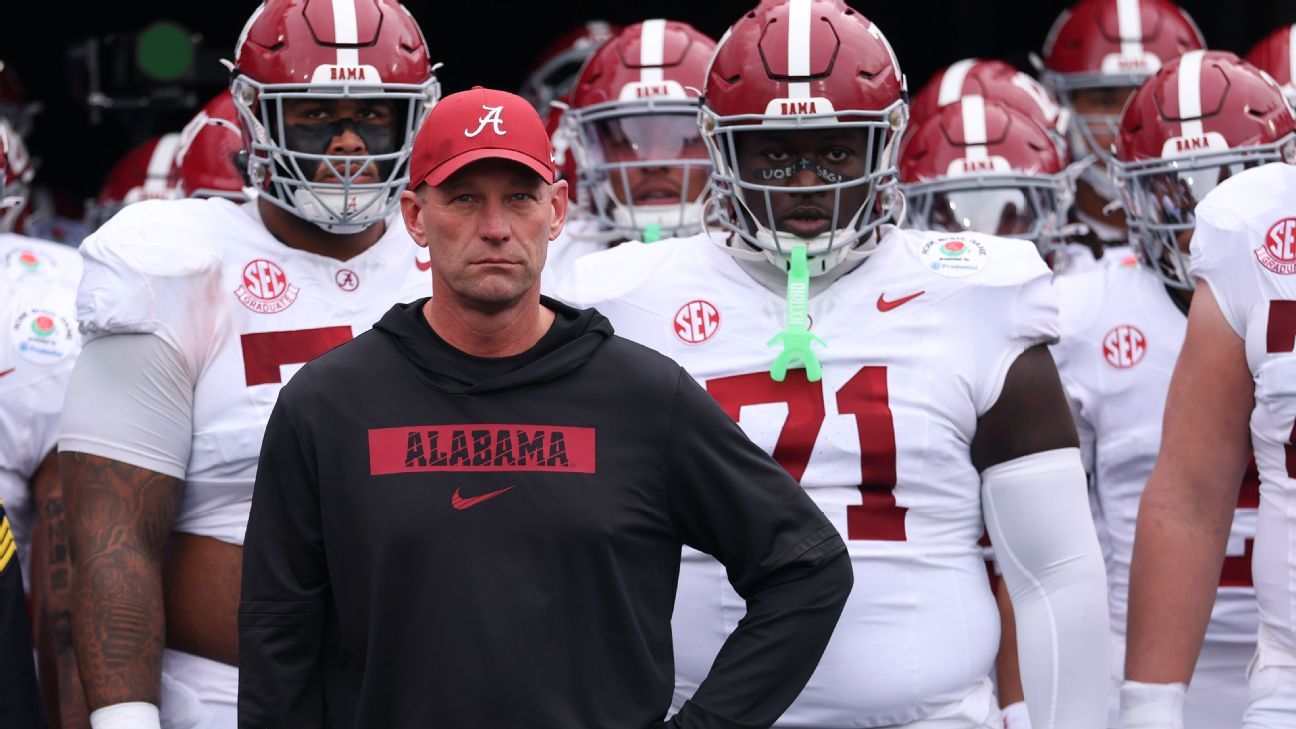
This is one of two rematches. OU's 23-21 win in Tuscaloosa in November wasn't the season's most aesthetically delightful game, but it was vital to how the rest of the season played out. With a Bama win, the Crimson Tide would have likely earned a first-round home game, and OU would have been out. Regardless, Bama gets a shot at redemption after a late-season fade, and OU gets to show off both its brilliant home crowd and a speedy, opportunistic defense.
Bama's 3 biggest plays of 2025
Before we talk about matchups, let's also look at the plays that got each team to this point. Here are Alabama's top three plays of the season in terms of win probability added (per ESPN analytics). Without them, the Tide would probably be sitting at home right now.
1. Week 9 vs. South Carolina: Tim Keenan III's recovery of a LaNorris Sellers fumble forced by Deontae Lawson (1:51 left in Q4). Win probability added: 34.3%.
After a clutch run of four straight wins over ranked teams, Bama almost immediately stumbled. The Tide trailed South Carolina by eight late before Ty Simpson tied the game with a touchdown pass and 2-point conversion. South Carolina had time to drive for the winning score, but Keenan's fumble recovery set up a game-winning touchdown from Germie Bernard instead.
2. Week 8 vs. Tennessee: Zabien Brown's 99-yard pick-six off of Joey Aguilar (0:09 left in Q2). Win probability added: 19.6%.
In its run against ranked opponents, Bama beat only Tennessee by a comfortable margin (37-20). That margin was almost entirely provided by the two-touchdown swing that occurred when Brown stepped in front of a goal line pass and took it the length of the field.
1:05
Pick-six! Zabien Brown takes it 99 yards to the house for Alabama
Zabien Brown intercepts Joey Aguilar in the red zone and returns it 99 yards for an Alabama touchdown.
3. Week 14 vs. Auburn: Bray Hubbard's interception (and 34-yard return) of Ashton Daniels (1:02 left in Q3). Win probability added: 18.3%.
Bama again struggled with a sub-.500 underdog in the Iron Bowl. Before Simpson's fourth-down TD to Isaiah Horton could give the Tide a late lead, they needed this red zone pick, late in the third quarter, to buy some time.
OU's 3 biggest plays of 2025
Let's see if we can spot a trend here.
1. Week 14 vs. LSU: John Mateer's 58-yard touchdown pass to Isaiah Sategna III (4:26 left in Q4). Win probability added: 27.4%.
0:42
John Mateer connects with Isaiah Sategna III to give Oklahoma the lead
John Mateer finds a wide open Isaiah Sategna III for a 58-yard touchdown to put the Sooners on top.
2. Week 13 vs. Missouri: Mateer's 87-yard touchdown pass to Sategna (6:59 left in Q2). Win probability added: 23.3%.
3. Week 14 vs. LSU: Mateer's 45-yard touchdown pass to Deion Burks (1:57 left in Q3). Win probability added: 21.0%.
Oklahoma got here by combining dynamite defense with random offensive bursts. Among CFP receivers, Isaiah Sategna III is third in receiving yards, but he might be the CFP's most important receiver. And while Deion Burks is mostly a possession option, his longest catch of the season, a 45-yard burst from a tunnel screen, was crucial too.
Last time: Oklahoma 23, Alabama 21
OU's Eli Bowen scored on an 87-yard pick-six, Taylor Wein blocked a second-quarter field goal attempt, and the Sooners' offense got points from drives of 25 yards (after a long Sategna punt return), 31 yards (muffed punt) and 22 yards (another fumble) to win. All of that was required to overcome a 406-212 yardage disadvantage and vastly inferior success rate*. My Postgame Win Expectancy figure (PGWE) takes the predictive stats from a given game (the stuff that eventually feeds into SP+), tosses them into the air and says, "With these stats, you would have won this game X% of the time." The Sooners' PGWE was 5.0%. It was the fifth-lowest PGWE of the year for a winning team.
(*Success rate: how frequently an offense is gaining 50% of necessary yardage on first down, 70% on second and 100% on third and fourth.)
Lowest Postgame Win Expectancy in a win, 2025
Louisiana 42, Texas State 39 (2.0% PGWE)
Air Force 26, San Jose State 16 (2.5%)
Louisiana 30, Louisiana-Monroe 27 (3.3%)
Sam Houston 21, Oregon State 17 (4.4%)
Oklahoma 23, Alabama 21 (5.0%)
Of course, while the Sooners' win in T-Town wasn't done in a sustainable fashion, Bama has primarily looked worse since.
Can Ty Simpson get his mojo back?
After a season-opening dud against Florida State, Alabama ripped off eight straight wins thanks in large part to brilliance from quarterback Ty Simpson. But the Tide's run game never really came around, and it's hard to carry an offense for an entire season. Simpson's numbers cratered late.
Simpson, first 10 FBS games: 80.6 Total QBR, 67% completion rate, 7.4 yards per dropback, 81.1% catchable pass rate
Simpson, last two games: 55.1 Total QBR, 51% completion rate, 3.7 yards per dropback, 70.3% catchable pass rate
Simpson's footwork and accuracy betrayed him in the SEC championship game. He has had a couple of weeks to rest, and Bama has had a couple of weeks to generate proper disrespect energy from those (justifiably) questioning how they managed to make the CFP. But righting the ship against an aggressive Oklahoma defense is tough. The Sooners rank second nationally in success rate allowed, third in stuff rate, third in sack rate, fourth in three-and-out rate and fifth in red zone TD rate allowed. Defensive ends Taylor Wein and R Mason Thomas have combined for 22.5 TFLs and 12.5 sacks despite Thomas missing three games with injury -- he's expected to play on Friday -- while cornerbacks Courtland Guillory and Eli Bowen have allowed just a 38% completion rate in coverage.
Only Texas and Ole Miss found any real passing success against the Sooners, and they did it in opposite ways. Texas' Arch Manning went 21-for-27 but averaged only 7.9 yards per completion. Ole Miss' Trinidad Chambliss, meanwhile, went just 24-for-44 but completed five passes of at least 25 yards. The Rebels were the only team to top 30 points on the Sooners.
This would be a fantastic time for Ryan Williams to finally find his way. The preseason All-American suffered a catastrophic drop rate of 13.4% (national average: 5.0%) during an almost seasonlong sophomore slump. He caught just nine of 18 balls with three drops in his past five games. Senior Germie Bernard is good, but Bama desperately needs big plays, and Williams is -- or was -- the most likely producer of those.
Can OU's offense score without help?
Oklahoma has reached the CFP despite an offense that ranks 95th in yards per play and 89th in points per drive. The Sooners' averages suffered a downturn after quarterback John Mateer's midseason hand injury, but they weren't spectacular before that either.
The Sooners have by far the least efficient attack in the CFP.
This isn't a good offense, but it's a timely one. Dam-bursting passes to Sategna and Burks were vital, as was outstanding red zone execution: The Sooners rank 16th in red zone TD rate (72%), and Groza-award-winning kicker Tate Sandell all but guarantees points from any scoring chance.
Against an excellent Bama defense, yards should again be hard to come by. The Tide are eighth in defensive SP+, driven by a disruptive run defense and safe, zone-heavy pass defense. Safety Bray Hubbard roams in the back, and sophomore OLB Yhonzae Pierre has become a star: He's sixth among CFP defenders in tackles for loss (13.5) and third in forced fumbles (three), and he had a pair of pressures and a pair of run stops in the first OU game. Bama's iffy late performances had very little to do with the defense.
Projections
DraftKings projection: Bama 21.0, Oklahoma 19.5 (Bama -1.5, over/under 40.5)
SP+ projection: Oklahoma 24.4, Bama 21.1
Bama probably should have won the first matchup, but the Tide failed to even slightly look the part down the stretch, and no playoff team knows itself -- and what it needs to do to win -- better than Oklahoma.


No. 10 Miami at No. 7 Texas A&M
Brilliance and droughts, explosions and implosions. Maybe the two most volatile teams in the CFP will face off in Saturday's early game and in what sure looks like the most interesting first-round game on paper. Tell me right now that either team wins by 24 points, or that the game goes to 16 overtimes, and I'll believe you.
Miami's 3 biggest plays of 2025
You might want to skip these next two sections, Notre Dame fans.
1. Week 1 vs. Notre Dame: Carter Davis' 47-yard field goal (1:08 left in Q4). Win probability added: 24.1%.
2. Week 1 vs. Notre Dame: Rueben Bain Jr.'s interception of CJ Carr (12:05 left in Q4). Win probability added: 15.7%.
Miami's entire playoff case was built around beating Notre Dame, and the Hurricanes needed a number of key plays to get the job done. After the Irish tied the game with 3:21 remaining, Davis knocked in the go-ahead points. Back-to-back sacks by Akheem Mesidor and Bain sealed the deal and, 14 weeks later, earned Miami its first CFP berth.
3. Week 10 vs. SMU: Holding on SMU (0:47 left in Q4). Win probability added: 15.2%.
It's probably telling that the third-biggest WPA play of the season was a penalty on an opponent who went on to score and beat the Canes. Close games haven't been the Hurricanes' thing. Their two one-score victories involved a blown 14-point lead against Notre Dame and a nearly blown 25-point lead against Notre Dame, and playing things safe late against both Louisville and SMU resulted in eventual losses.
A&M's 3 biggest plays of 2025
1. Week 3 vs. Notre Dame: Marcel Reed's 11-yard touchdown pass to Nate Boerkircher on fourth-and-11 (0:19 left in Q4), plus Randy Bond's PAT. Win probability added: 88.4%.
2. Week 3 vs. Notre Dame: Defensive holding on Notre Dame on third-and-16 (0:46 left in Q4). Win probability added: 21.0%.
If Bama-Oklahoma was the least likely outcome of the CFP race, the single biggest play came in South Bend at the end of maybe the best game of the season. A&M erased deficits to either tie or take the lead on four occasions. After Notre Dame's Jeremiyah Love scored the go-ahead TD with 2:53 left, a botched hold on a PAT left the door cracked, and after Reed and Boerkircher connected on fourth-and-long, Bond's PAT won the game.
3. Week 12 vs. South Carolina: Tyler Onyedim and Dalton Brooks's sack of LaNorris Sellers for an 11-yard loss (2:00 left in Q4). Win probability added: 20.1%.
Somehow Notre Dame wasn't even A&M's wildest win of the year. The Aggies spotted South Carolina a 30-3 halftime lead thanks in part to a 3-for-15 funk from Reed -- one that also featured three Reed turnovers and two missed field goals. Their win probability at halftime was 3%, but they calmly scored four second-half touchdowns in 20 minutes and finished off a stunningly easy comeback with a fourth-down stop.
Which defense forces more mistakes?
These two defenses are fantastic at forcing opponents behind schedule and pouncing on mistakes. These two offenses, meanwhile, make a few too many mistakes at times.
A&M's defense is crafted around forcing third-and-longs: Linebacker Daymion Sanford and defensive tackle Tyler Onyedim have combined for 27 run stuffs (stops at or behind the line), and A&M's 7.6 TFLs per game rank third nationally. A whopping 73% of opponents' third downs require 7 or more yards (most in the nation), and it therefore isn't surprising that the Aggies allow the lowest third-down conversion rate in the country (22.3%) and, thanks in part to Cashius Howell's 11.5 sacks, they have the highest sack rate in the country (9.7%).
There's a trade-off for this aggression: Opponents can make some awfully big plays against them at times.
The Aggies have the most all-or-nothing defense in college football.
Miami's defense combines nearly the same efficiency levels with far lower risk and fewer big-play glitches. Thanks in part to Bain and Mesidor, the Hurricanes have forced the highest blown block rate in the country. At the back, another dynamite duo, nickel Keionte Scott and safety Jakobe Thomas, has combined for 14.5 tackles for loss, 13 run stops, 7 pass breakups, 6 sacks, 5 interceptions, 4 forced fumbles and 3 forced fumbles. (And a partridge in a pear tree!) For all of A&M's aggression, the Canes have forced over twice as many turnovers as the Aggies (20 to nine).
I probably shouldn't overstate these offenses' deficiencies. Miami's offense ranks 10th in success rate and 20th in red zone TD rate; freshman Malachi Toney has emerged as a fantastic source of efficiency: He has a 78% catch rate, he hasn't been credited with a single drop, and he has forced 31 missed tackles, most of any CFP receiver.
A&M, meanwhile, stretches defenses both horizontally -- speedsters KC Concepcion and Mario Craver are similarly dangerous at taking short passes longer distances -- and vertically, with redshirt freshman Ashton Bethel-Roman emerging as a deep threat late in the season and a number of tight ends reeling in passes up the seam. It's a wonderfully structured attack, and thanks to both strong offensive line play and Marcel Reed's own elusiveness, the Aggies don't suffer many negative plays.
Still, both offenses can be mistake-prone in their own ways. A&M commits too many penalties and ranks a mediocre 60th in third-down conversion rate, and Reed's 10 interceptions are tied for the most of any CFP QB. Miami, on the other hand, boasts low explosiveness levels -- 11.3 yards per successful play (119th), 6.6% of snaps gaining 20-plus yards (66th) -- and ends up having to use quite a few snaps to work the ball into scoring position. More snaps equal more opportunities for mistakes, and despite throwing as many short and safe passes as anyone in the CFP, Beck has also thrown 10 INTs. The combination of A&M's risk-heavy defense with Miami's risk-averse offense should be fascinating.
Who gets the run game going?
What's one time-tested way to fend off good pass rushes and avoid interceptions? Run the damn ball. Both A&M and Miami have been willing to do that in 2025. Miami's Mark Fletcher Jr. and CharMar Brown average 20 carries per game with an excellent 54.4% success rate, while a number of A&M backs led by Rueben Owens II and, if healthy, Le'Veon Moss, have produced similar volume and efficiency numbers. (Moss has missed the past six games, and his availability appears questionable.)
The run defenses appear better than the run offenses, however. A&M is 10th in rushing success rate allowed, and while the Aggies can get hit by the big run gash, Miami doesn't make many of those. And while A&M's run game is 39th in yards per carry (not including sacks), Miami's run defense is 16th. If one offense finds more advantages on the ground than the other, that advantage could make a huge difference.
Projections
DraftKings projection: A&M 26.8, Miami 23.8 (A&M -3, over/under 50.5)
SP+ projection: A&M 28.7, Miami 26.1
Both of these teams are capable of blowout wins or losses here, but if A&M has the edge overall, we'll say it's because of what might happen in close games. The Aggies are 4-0 in one-score finishes and have proved capable of winning both track meets (41-40 over Notre Dame, 45-42 over Arkansas) and rock fights (16-10 over Auburn). We already talked about Miami's cautious late play above. If it's close heading into the late stages, the advantage shifts to the home team.
Read more: An Ivy Leaguer in Aggieland


No. 11 Tulane at No. 6 Ole Miss
Saturday, 3:30 p.m., TNT/HBO Max/truTV
We've seen six rematches this season; in five instances, the loser of the first game won the second.
There were some big swings there, though granted, there weren't any 35-point swings. That's the margin by which Ole Miss beat Tulane in Week 4.
Tulane's 3 biggest plays of 2025
1. Week 7 vs. East Carolina: Jake Retzlaff's 63-yard touchdown pass to Zycarl Lewis Jr. (11:01 left in Q4). Win probability added: 24.8%.
Tulane got used to doing things the hard way in 2025, going 5-0 in one-score games, and things got particularly tricky in mid-October. The Green Wave dominated East Carolina in the first half but managed just four field goals and a failed fake in five scoring chances. They led only 12-0, and ECU charged ahead 16-12 in the second half. But Lewis' long touchdown early in the fourth quarter turned the tide, and a short Javin Gordon touchdown with 35 seconds left ensured a 26-19 win.
0:59
Jake Retzlaff throws 63-yard touchdown pass vs. East Carolina
Jake Retzlaff connects for 63-yard TD pass
2. Week 8 vs. Army: Retzlaff's 12-yard touchdown pass to Bryce Bohanon on fourth-and-8 (2:00 left in Q4). Win probability added: 24.5%.
3. Week 8 vs. Army: Retzlaff's 37-yard touchdown run (5:01 left in Q3). Win probability added: 20.6%.
The Wave needed more magic a week later when they got caught in a customary Army slog. Retzlaff's touchdown run tied the game at 10-10, but Army went ahead again with six minutes remaining. No worries: Tulane simply won nearly every play after the two-minute timeout. Retzlaff and Bohanon tied the game on fourth down, Army went three-and-out, and Tulane scored the game winner with 27 seconds left.
The Wave followed up on these two tight wins by getting their doors blown off by UTSA. Suboptimal. But they went unbeaten in November and toppled North Texas in the American championship game. No one can question their resilience.
Ole Miss' 3 biggest plays of 2025
1. Week 12 vs. Florida: Kewan Lacy's 59-yard run (0:12 left in Q3). Win probability added: 22.8%
2. Week 8 vs. Georgia: Trinidad Chambliss' 75-yard touchdown pass to De'Zhaun Stribling (14:57 left in Q3). Win probability added: 20.8%.
3. Week 3 vs. Arkansas: Wydett Williams Jr.'s recovery of a Jalen Brown fumble, forced by TJ Dottery (2:00 left in Q4). Win probability added: 20.3%.
In 2024, Ole Miss won 10 games by an average of 32.8 points but lost three one-score heartbreakers. In 2025, the Rebels haven't been nearly as dominant, but they went 5-1 in one-score games, falling only at Georgia.
Obviously they'll have to deal with a new sort of challenge with defensive coordinator Pete Golding taking over for Lane Kiffin, but when challenged, lots of different Rebels have come up with big plays in key moments. Against Arkansas early on, the defense, torched in the first half, made three stops in four Razorback possessions and forced a game-clinching fumble. Against Florida late in the year, Lacy bullied his way to 224 yards and three touchdowns, using a 59-yard charge to set up a go-ahead touchdown early in the fourth quarter.
Last time: Ole Miss 45, Tulane 10
Ole Miss' Week 4 win was pretty decisive. But the Green Wave truly couldn't have played any worse. Left tackle Derrick Graham was out, and Jake Retzlaff faced a 40% pressure rate and was forced to scramble constantly; it was the first game in which the chemistry between Retzlaff and the receivers he had only recently met -- he committed to transfer to Tulane in late July -- was tested, and Retzlaff went a dreadful 5-for-17 for 56 yards. Three games later, Army pressured Retzlaff a similar amount, and he went 22-for-29.
The Tulane defense was in an awkward position as well. Ole Miss quarterback (and Ferris State transfer) Trinidad Chambliss had started only once in place of the injured Austin Simmons, and his tendencies were unclear. The Green Wave sent the house at him, and he torched them for five completions of 30-plus yards to four different receivers, plus a 41-yard run. Tulane limited Lacy to just 68 yards on 18 carries, and it didn't matter.
Chambliss would torch plenty of other defenses on his way to a No. 8 Heisman finish and No. 5 Total QBR ranking.
How Tulane got right
If nothing else, Retzlaff has better chemistry with his receivers, and Tulane knows what it's dealing with in Chambliss. That could make a solid difference, as could the simple fact that, after another "blitz a lot and get burned" game against UTSA, head coach Jon Sumrall and defensive coordinator Greg Gasparato seemed to better adapt to their defense's strengths and weaknesses.
During the Green Wave's current five-game winning streak -- a run that included games against excellent Memphis and North Texas offenses -- they've blitzed far less, deployed more defensive backs on average and played more safe zone coverage. They've sacrificed a little size for speed, and it has somehow all minimized catastrophes while also increasing disruption levels.
Perhaps most encouragingly, the Wave improved in virtually every game in this stretch. They forced five North Texas turnovers and held the Mean Green to a season-low 21 points (most of which came after they had gone up 31-7). If they can keep Ole Miss in the 20s, they'll give themselves a chance.
Ole Miss is still the favorite for a reason
The Rebels proved their tenacity by playing well late in the season despite the constant swirling of Kiffin rumors. (Hell, Kiffin's departure might galvanize them even further.) They've scored 30 or more in all but two games, and after allowing 43 points in a track-meet loss to Georgia, the Rebels' defense overachieved at least slightly against SP+ projections in four of its past five games.
This year's Ole Miss offense is both less explosive and less one-note than last year's. It has improved from 75th to 40th in rushing success rate thanks to Lacy, who averages only 5.0 yards per carry but takes on a heavy load and keeps Chambliss in mostly friendly downs and distances. And on the rare third-and-longs, Chambliss has been fantastic: Ole Miss' 38.1% success rate on third-and-7 or more is fourth nationally. The receiving corps doesn't have a single go-to guy, but five different players have caught between 30 and 46 passes.
The Rebels' defense is solid against the pass, as Tulane can probably attest -- they're 19th in both completion rate and passing success rate allowed. Cornerback Antonio Kite has been in and out of the lineup with injury, but Chris Graves Jr. is good. And while the run defense is flawed, rushing isn't a Tulane strength: The Green Wave rank 22nd in yards per dropback but 75th in yards per (non-sack) rush.
Projections
DraftKings projection: Ole Miss 37.0, Tulane 19.5 (Rebels -17.5, over/under 56.5)
SP+ projection: Ole Miss 38.5, Tulane 20.6
I do expect Tulane to play much better this time around, and if the Green Wave give Lacy his yards but don't get burned by big plays, they should make this a pretty fun and competitive game. But we're still probably going to end up with a Georgia-Ole Miss quarterfinal rematch.


No. 12 James Madison at No. 5 Oregon
Saturday, 7:30 p.m., TNT/HBO Max/truTV
We've seen some hand-wringing regarding James Madison's inclusion in the CFP; considering how long mid-majors had to fight for one playoff spot, getting two has offended the sensibilities of some people whose sensibilities, frankly, needed offending. But the Dukes would have been betting favorites against ACC champion Duke, and Oregon ranks fourth in SP+ and third in FPI. The Ducks were going to be big favorites regardless because they're awesome. Still, they must take care of business against a JMU team that is, on paper, superior to the Boise State squad that outgained Penn State last year in an eventual quarterfinal loss.
James Madison's 3 biggest plays of 2025
1. Week 13 vs. Washington State: Wayne Knight's 58-yard touchdown run (6:33 left in Q4). Win probability added: 27.2%.
0:40
Wayne Knight scores 58-yard rushing touchdown
Wayne Knight scores 58-yard rushing touchdown
2. Week 13 vs. Washington State: Alonza Barnett III's 68-yard touchdown pass to Braeden Wisloski (2:26 left in Q3). Win probability added: 23.2%.
3. Week 7 vs. Louisiana: Barnett's 62-yard touchdown pass to Landon Ellis (14:55 left in Q3). Win probability added: 17.4%.
I see a trend there!
The JMU defense has been strong all season, albeit against offenses weaker than Oregon's. Louisville gained just 264 yards on the Dukes, who rank first in success rate allowed.
The offense, meanwhile, averaged 46.0 points per game and 7.2 yards per play in its final seven games. And when necessary, the Dukes could press the Big Play button. They got two long TDs in the second half of a tight game against Wazzu (which also nearly beat Ole Miss), and another long TD bailed them out against Louisiana. A huge Knight TD run defined their Sun Belt title game win, too.
Oregon's 3 biggest plays of 2025
This was the season in which Oregon officially became a Big Ten team: The Ducks' biggest plays came from either defense or special teams.
1. Week 5 vs. Penn State: Dillon Thieneman's interception of Drew Allar (OT). Win probability added: 64.7%.
2. Week 11 vs. Iowa: Atticus Sappington's 39-yard field goal (0:07 left in Q4). Win probability added: 52.5%.
3. Week 7 vs. Indiana: Brandon Finney Jr.'s pick-six off of Fernando Mendoza (12:53 left in Q4). Win probability added: 28.8%.
Oregon's offense is efficient and reliable, though the Ducks are 13th in offensive SP+, their least awesome ranking under Dan Lanning. But they're also fifth in defensive SP+, their best ranking in 67 years, and the defense came up huge in huge moments. Thieneman's overtime interception quickly ended Penn State's comeback attempt in State College, and with the offense stalling out against Indiana, Finney's pick-six tied the score at 20-20 early in the fourth quarter of an eventual defeat. Plus, Sappington's game-winning field goal allowed the Ducks to out-Iowa Iowa in Iowa City.
Can a 12 beat a 5?
From a power ratings perspective, Oregon-JMU is loosely equivalent to a 1- or 2-seed facing a 7- to 10-seed in the second round of the NCAA basketball tournament. Over the past five men's tourneys, 1s and 2s have gone 29-7 in those second-round matchups after going 36-4 in the first round. Those are high win percentages, but we constantly see upsets because there are eight 1- or 2-seeds each year. Based on SP+ projections and the DraftKings line, this is an upset we might see once every seven or eight meetings, but we get only one bite at the apple, not eight.
If an upset occurs, it should follow a familiar formula. I've written about what usually happens when mid-majors upset powers, and it's a recipe JMU is built to follow.
Score touchdowns, force field goals: JMU scores TDs on 71.2% of red zone trips (20th) and allows TDs on just 51.6% (19th). Oregon's offense is strong in this regard (30th), but the defense is strangely poor (129th). Taking advantage of that is a must.
Dominate third and fourth downs: JMU converts 47.4% of third downs (18th) and allows opponents just 28.7% (fifth). The Dukes are super aggressive against the pass, going hard after both receivers (third in completion rate) and QBs (13th in sack rate, led by redshirt freshman Sahir West). And while that leaves you susceptible to big plays, it also creates third-and-longs. Even with the best lines JMU has faced, Oregon doesn't do an amazing job of either creating or avoiding third-and-longs.
A couple of big plays: Not only is Knight explosive, but his explosive rushes are enormous -- he has 15 carries of 20-plus yards, and seven went 40-plus. Meanwhile, though Alonza Barnett III has the lowest Total QBR in the CFP (he's 64th overall), his big completions are similarly huge: On passes thrown at least 20 yards downfield, he averages 39.9 yards per completion. Receivers Landon Ellis and Nick DeGennaro are particularly dangerous.
JMU doesn't hit doubles or triples -- it's all singles and home runs. With few missed tackles and safeties Dillon Thieneman and Aaron Flowers roaming at the back, Oregon might have the nation's best big-play prevention defense. But just two home runs might go a long way.
Turnovers: This one will require some luck. JMU has just a minus-1 turnover margin, and the team must be on the positive side in Eugene. Maybe rainy conditions will help. (Or hurt.)
What we could learn about Oregon (even in a comfortable win)
Lanning teams are capable of messing around against mid-major competition. At the start of last season's 13-0 run, the Ducks struggled to put away Jason Eck's Idaho, then needed two return scores to beat Boise State. Still, it's hard to shake the memory of the Fiesta Bowl two seasons ago, when, after narrowly missing out on a CFP berth, Oregon absolutely erased Liberty 45-6, scoring on seven of the first eight possessions and nearly doubling the Flames' yardage.
JMU grades out better than 2023 Liberty, especially on defense, but Oregon is an elite team with a ruthless side. Obviously a blowout is on the table. But even in an easy Ducks win, there are two things I want to see to better understand their chances of making a playoff run.
Dante Moore on passing downs. Moore has been strong in his first year as starting quarterback, but injuries at receiver have caused some ups and downs. Dakorien Moore has missed four games, Gary Bryant Jr. has missed three, star tight end Kenyon Sadiq missed one, and Evan Stewart, last year's No. 2 WR, hasn't played yet because of a torn patellar tendon. Others, such as Malik Benson and Jeremiah McClellan, filled in pretty well, but against Indiana, Wisconsin and Iowa, Moore averaged just 4.2 yards per dropback with three interceptions and eight sacks. And Oregon's 2025 performance has been heavily dependent on staying on schedule -- the Ducks are first in success rate on standard downs* but 65th on passing downs.
(*I define standard downs as first downs, second-and-7 or less, and third- and fourth-and-4 or less. Passing downs are everything else.)
Dakorien Moore, Bryant and Stewart have all been practicing this week, which is tantalizing. But even if an elite and deep Oregon run game is churning nicely and Oregon isn't behind schedule much, Dante Moore's performance on passing downs could be telling.
Defensive disruption. Oregon's defense ranks just 98th in stuff rate and 47th in sack rate. The Ducks' big-play prevention levels are great, but negative plays are cheat codes in big games, and I'd love to see a bit more disruption, especially against the weakest (on paper) team they'll face in the CFP.
Projections
DraftKings projection: Oregon 34.5, JMU 13.0 (Ducks -21.5, over/under 47.5)
SP+ projection: Oregon 34.3, JMU 18.9
We know Autzen Stadium will be a cauldron, and the weather could provide the sloppiness you might want from a December game in the Pacific Northwest. The entertainment value should be solid even if JMU can't keep up, but if the Dukes follow the upset script, this could be that one-in-eight game.