 3 months ago
120
3 months ago
120
27 minutes ago
Steve RosenbergRussia Editor
Watch: How Russia's internet crackdown is affecting its people
Near the Kremlin several dozen people are queuing outside the presidential administration office.
They've come to submit petitions calling on President Vladimir Putin to end a crackdown on the internet.
Russian authorities have been tightening control of the country's cyber space. Access to global messaging apps has been restricted and there are widespread disruptions to, even shutdowns of, mobile internet.
Petitioning the president is legal. But in an authoritarian state this is putting your head above the parapet.
And people are being made to feel that.
From across the street security officers are filming the petitioners – and us.
"Aren't you scared?" I ask Yulia in the queue.
"Very scared," she replies. "I'm shaking."
Putin has acknowledged the disruption, describing it as related to "operational work to prevent terrorist attacks", although he says he has instructed officials to allow for the "uninterrupted operation" of essential internet services.

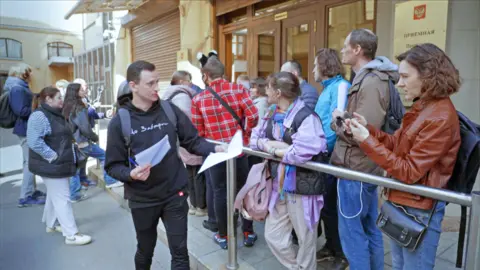
Russians can legally petition the president but sticking your head above the parapet comes with a real risk
Yulia, who owns a catering company, explains how attempts to censor the internet have affected her business.
"There were times recently when our website was not accessible. We couldn't generate revenue," she says.
"We are losing money every time there is a blocking of the internet, a blocking of [messengers] Telegram and WhatsApp. My business is entirely on the internet. Without internet access, in this form it will not exist."
Russian officials insist that curbs on communication are in the interests of public safety. They claim that mobile internet blackouts disorient Ukrainian attack drones, although such attacks have continued even in areas where the internet has been switched off.
The authorities accuse global messengers of ignoring Russian data laws. Access to WhatsApp and Telegram has been heavily restricted. Meanwhile, state regulators are targeting VPNs - virtual private networks used to circumvent restrictions.
As part of the push for a "sovereign internet", the government is promoting a state-backed Russian messenger called MAX.
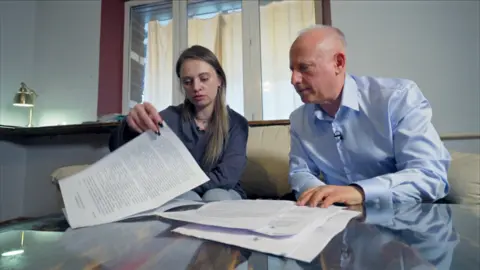
Yulia Grekova tried to organise a protest against the internet restrictions but was blocked by the authorities
"Many people think that this messenger is made especially by the government to check our messages," says former MP Boris Nadezhdin, who once tried to stand against Putin in a presidential election.
What's more, in many parts of Russia now the only sites and services that open on a mobile phone are those approved by the government.
It feels like a digital "Iron Curtain" is being constructed.
"The idea is to divide Russia from the outside world," says columnist Andrei Kolesnikov, from opposition outlet Novaya Gazeta, because of the belief that "this world is poisonous to the brains of Russians".
"Russia was always blocked, primarily from the West, which was the source of 'bad, revolutionary, liberal ideas'. It was always like this."
Yet Russians embraced the digital age and the internet to such an extent that cyber restrictions and disruptions have come as a shock.
"It's less to do with freedom of speech and more about habit," activist Yulia Grekova explains.
"People have got used to paying for things and ordering taxis with their mobiles. They sit in the bus messaging friends. There are very few people who don't use mobile internet for work, public services and to keep in touch with family. That's why there's such an angry reaction. Everyone's affected."
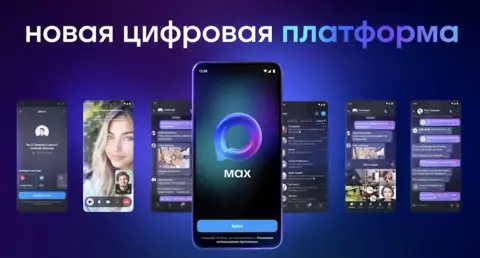 MAX
MAX
The Kremlin is encouraging Russians to use a state-approved messaging service called MAX, but many are wary it will be used for surveillance
I'm speaking to Yulia Grekova in the town of Vladimir, 120 miles (190km) from Moscow. She recently tried to hold a rally here against internet restrictions.
"We applied to the local authorities and suggested several options for a venue. They replied that this wasn't possible, since on the date we'd requested they would be cleaning the streets at all 11 of our proposed locations.
"City Hall offered an alternative venue and time. But later they said this wasn't possible either, due to the danger of [Ukrainian] drone attack."
Then Yulia received a visit from the police and a warning not to protest.
"They came to where I work. A police car and three people. They filmed me signing the official warning from the prosecutor. I felt like some kind of terrorist."
Similar applications for public protests were rejected in dozens of Russian towns and cities. In the Moscow region local authorities cited coronavirus concerns. Officials in Penza claimed that a rally couldn't go ahead due to a roller-skating masterclass at the requested location.
In the centre of Vladimir I check my phone. The taxi booking app is functioning and I can access state media. But Google searches aren't working. And independent news sites aren't loading.
"It's much harder to communicate," says Maria, who is out strolling with her baby. "We want to keep across the latest news and trends. Instead, we're lagging behind."
The longer we chat, though, the less Maria seems to want up-to-date information.
"In the past, when there was no internet, the world seemed a brighter place, because we knew less," she tells me.
As for Russia's war on Ukraine: "I try to avoid this kind of news," Maria says. "I don't want to fill my head with it. We're tired of news about people being killed."
"[Internet restrictions] create daily problems," says Denis. "Today I couldn't pay for petrol. And my satnav is glitching."
"People are annoyed," Alexander tells me. "Especially those with small businesses. They lose customers when they can't access the internet."
"It feels like we're going backwards," says Yulia Grekova, "sliding back to the past."
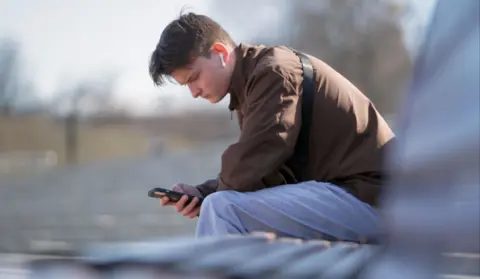
The internet was limited in the town of Vladimir when the BBC visited
Is Russia's internet crackdown a road to the past?
"No, it's not," Putin's spokesman Dmitry Peskov assures me back in Moscow.
"In the current situation, security considerations dictate the need for certain measures," Peskov continues. "These are being taken and most of our citizens understand the need for them.
"It's clear that internet restrictions inconvenience many people. But this is the period we're in. Once the need for such measures disappears, services will be fully restored and return to normal."
But restrictions and repression are beginning to feel like the new normal.
"I don't think that this regime is ready to go back," concludes journalist Andrei Kolesnikov. "They can only go forward in terms of more repressions.
"What is bad for the authorities is an accumulation of discontent and it could play out in the future. We don't know in what shape. But it's evident that irritation and discontent are accumulating."
And bubbling to the surface.
Recently Russian celebrity blogger Victoria Bonya posted an "address to Russia's president" on Instagram. She slammed the internet crackdown and other controversies in Russia.
The video went viral with tens of millions of views. In her monologue Victoria Bonya didn't blame Putin directly. But addressing him she declared: "There is a huge, thick wall between you and us, the ordinary people."
On Thursday the Kremlin leader claimed he could not help but "pay attention" to the problems Russians have been experiencing as a result of internet disruption.
He instructed law enforcement bodies to show "ingenuity and professionalism" and to "accommodate the vital interests of citizens".
This was no U-turn from Putin. There was no hint of an end to the restrictions.
Recent surveys in Russia suggest that his ratings have fallen to their lowest level since the full-scale Russian invasion of Ukraine in 2022.
It's not just internet restrictions fuelling public unease. Russians are worried about the economy and there is growing fatigue with the war on Ukraine.
"People begin to understand there is a direct connection between their everyday problems, like healthcare, food prices, problems with internet, and the politics of Vladimir Putin," Boris Nadezhdin tells me.
"And this is a new situation in Russia."
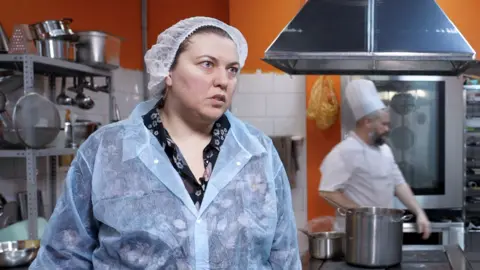
Caterer Yulia says her business relies on customers having access to the internet
Having submitted her petition to the presidential administration, Yulia is back at work, baking bread at her catering company.
She has taken a stand but is far from certain it will make a difference. She is already thinking about how to adapt to the online restrictions. Russians, she tells me, have much experience adapting to major change.
"My great-grandfather was wealthier than average. In a Soviet village that was considered a sin. His property was taken away from him and he was moved to Siberia. But his family adapted.
"My parents went through the collapse of the Soviet Union: they adapted to a market economy. Now it's my turn to adapt. Then it will be my daughter's turn."
How does Yulia see the situation developing in Russia?
"The future is not even mentioned in day-to-day conversations with friends and relatives," she explains. "It's like: what are we doing in three days, in a week, in a month?
"Nothing more than a month."
Like the bread I see expanding in the oven, rising across Russia is a deep sense of uncertainty.