 2 months ago
94
2 months ago
94
Jonathan Head,South East Asia correspondent, Bangkokand Thanyarat Doksone,Bangkok
Thailand election explained as voters head to the polls
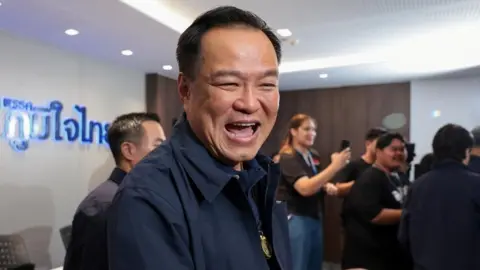
Prime Minister Anutin Charnavirakul has claimed victory in Thailand's general election, with early vote counts putting his ruling conservatives well ahead of their rivals.
Anutin said his success belonged to "all Thais, no matter whether you voted for us or not", after his party's expected result defied opinion polls that had placed the reformist People's Party ahead.
With almost 90% of the votes counted, Anutin's Bhumjaithai party projected to win 194 seats in Bangkok's 500-seat parliament, with the People's Party in second place on 115.
People's Party leader Natthaphong Ruengpanyawut appeared to concede the election, saying he was ready to serve in opposition if Anutin could form a government.
The election was called after several coalition governments collapsed, giving the country three prime ministers in as many years.
While no party is projected to gain an overall majority, paving the way for coalition talks, Anutin is now almost certain to stay in office.
Elections in Thailand are often unpredictable, and so it proved this time.
This shock result is a huge disappointment for the People's Party, which had expected to improve on its winning performance of three years ago.
But a widely expected "orange wave" of support for its young, idealistic candidates did not materialise.
The party, which won the election in 2023 but was blocked from taking power, found itself pushed into second place by Anutin's pragmatic conservatives.
The reformists will remain in opposition for now. The feared crisis that could have occurred had they won, and once again been barred from office, has been averted.

 Reuters
PM Anutin celebrated at his party's Bangkok headquarters
Opinion polls have frequently been wrong in Thailand, but there will be a lot of post-election analysis of how Anutin turned his once small, provincial Bhumjaithai - "Thai Pride"- party into a such formidable electoral machine.
Playing on patriotic sentiment after the two short border wars with Cambodia last year, Anutin's party became the standard-bearer for conservatives, promising to defend the status of traditional Thai institutions like the monarchy and military.
He campaigned on hard-line nationalist sentiments and populist giveaways - but his victory was also down to his ability to win local power-brokers to his side, in an electoral system where 80% of seats were decided on a first-past-the-post basis.
The People's Party did well in the proportional votes, where it appears to have got more votes than any other party. But it was unable to overcome its lack of networks at a local level.
The third main contender was the Shinawatra family and its Pheu Thai – "For Thais" – party, which is projected to win 86 seats.
In the past it dominated elections, with well-marketed populist policies. It had promised to create nine new millionaires – in Thai baht – every day through a national prize draw. Both Bhumjaithai and Pheu Thai have offered subsidies and cash handouts to voters.
Pheu Thai was expected to lose significant support in this election after its last coalition administration was accused of mishandling the conflict with Cambodia, and its patriarch, former PM Thaksin Shinawatra, was sent to jail.
 Getty Images
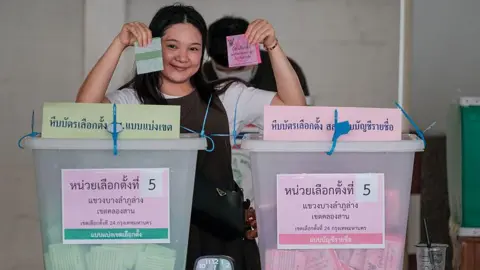
People in Thailand voted in the election throughout Sunday
Thailand's once dynamic economy has ground to a halt as political instability and the lack of structural changes worry foreign investors. Voters, meanwhile, had voiced concerns about rising costs.
"I want the economy to improve and I don't want big factories to relocate to our neighbouring countries," civil servant Phananya Bunthong told the BBC, a reference to Thailand falling behind Vietnam.
The People's Party promised big changes, from curbing the power of the biggest businesses and military, to streamlining the extensive bureaucracy and modernising the education system.
But in Thailand, even a straight election victory may not have been enough, as powerful, unelected forces have repeatedly intervened to block parties challenging the status quo.
Two previous incarnations of the People's Party were dissolved by the court, and their leaders banned from politics. When the young reformers won last time, the military-appointed senate barred them from forming a government and the constitutional court dissolved the party.
They are not the only ones to have been subjected to intervention by the constitutional court, and other unelected conservative institutions. Five Pheu Thai prime ministers have been dismissed by the court since 2008, and two earlier incarnations of the party have been dissolved.
But if the People's Party had exceeded the 151 seats it won in 2023, it may have proven difficult to bar it from forming a government. This is despite the great unease about its radical agenda in conservative and royalist circles.
The projected result means the People's Party's opponents will not be in this position, for now.
Besides the election, Thais have voted in a referendum on whether to reform the 2017 constitution, which was drafted under military rule in 2017.
Critics of the charter believe it gives too much power to unelected forces like the senate, "handcuffing" the country's democracy.
With over 90% of votes counted, preliminary tallies suggested around 65% had voted in favour.
"I want change. I don't want things to be the same," 28-year-old Kittitat Daengkongkho told the BBC.
That, in effect, was the choice Thai voters were presented with in this election: sweeping change, or more of the same.