 3 months ago
130
3 months ago
130
48 minutes ago
Nick EardleyPolitical correspondent

 Getty Images
Friday 20 June 2025 felt like a day of history in the House of Commons.
MPs approved a bill which would have legalised assisted dying in England and Wales. After a passionate and thoughtful debate, 314 MPs backed the bill – 291 voted against.
The decision was compared to some of the biggest votes on matters of conscience; the Abortion Act, legalising homosexuality and allowing gay marriage.
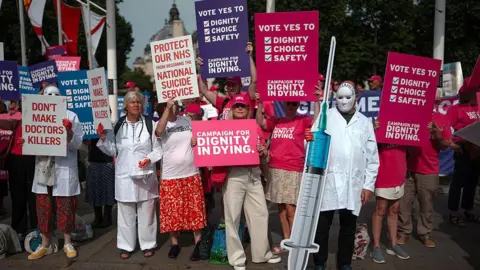
Campaigners outside Parliament, who had wanted the choice to end their own lives, were emotional and delighted.
Beside them in Westminster, opponents of the bill were disappointed. But they insisted the debate was not over.
Fast forward to today. After months of debate in the House of Lords, there was no moment where Parliament made its final decision in an historic vote.
Instead, time has simply run out. It had become increasingly clear as time went on that the Lords would not pass the bill in time.
Now, its journey is officially over.
To some, that will be a democratic outrage. Supporters of assisted dying are extremely frustrated at the way this process has played out in the Lords.
Hundreds upon hundreds of amendments were put forward.
The Lords does not work like the Commons – so they were all due to be discussed.
There simply wasn't the time to debate or vote on all the changes being suggested.
For backers of the bill, that is a sign that a small number of peers were able to frustrate the process – and effectively kibosh the will of MPs in the democratic elected part of Parliament.
But that isn't everyone's view. Others argue it is the job of the Lords to find problems with legislation – and try to solve them.
It might be frustrating to some – they argue - but it is how Parliament is supposed to work.
They also point out that some MPs who backed the bill proceeding didn't do so uncritically – they wanted to see more scrutiny and changes. Without them, they may not have backed the bill in a final vote in the Commons.
Remember too, this was a free vote. MPs weren't ordered to vote along party lines. But because it's seen as a matter of individual conscience it's not a change that was promised at the general election by Labour or the other larger parties.
This is a Private Members' Bill – which was brought forward by Labour MP Kim Leadbeater. It can't simply be brought back in the next session of Parliament, like a government bill.
It could however be brought back by another backbencher.
Every year, there is a ballot of MPs – with whoever wins getting the chance to suggest new legislation and priority for it to be debated on Fridays.
If another MP was so minded, they could bring back the exact same bill in the next Parliament.
In fact, supporters of assisted dying say they have so many MPs lined up, they are confident it will come back in the next session. One tells me more than 100 are ready - and another 100 could be persuaded.
It's possible the Parliament Act could be used, meaning peers could not block the bill a second time.
It would be unprecedented for a bill put forward by a backbench MP.
Would Parliament be comfortable using this rare process? And would MPs be comfortable with a piece of legislation they couldn't change again?
Perhaps a bigger question – do MPs actually want to focus their attentions on something else? Some have suggested Parliament should be focusing on the cost of living and defence – instead of another debate on this complicated and often divisive issue.
The assisted dying debate is complicated and difficult. The Scottish Parliament, with its one chamber, decided to reject assisted dying. The Isle of Man and Jersey have both backed it – but their bills have yet to receive royal assent.
This bill has reached the end of the road, when it comes to the law in England and Wales. The debate though is not over – and Parliament may yet revisit this important issue.