 1 month ago
104
1 month ago
104
26 minutes ago
Yolande KnellMiddle East correspondent, in Jerusalem

 BBC
BBC
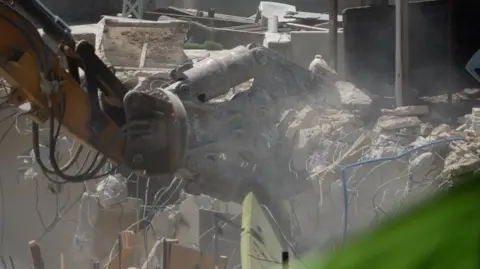
The Awad family home in East Jerusalem is one of the properties being demolished
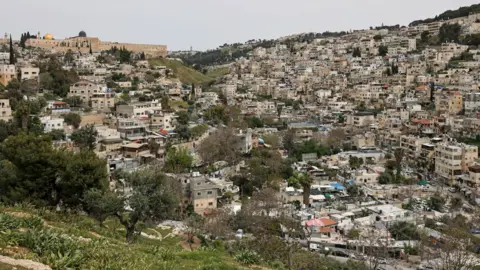
There is the loud din of a demolition below Jerusalem's walled Old City, and from a hillside I watch a large Israeli excavator tearing into a Palestinian house.
Some 59 properties have now been destroyed in the al-Bustan area of the Silwan neighbourhood since late 2023. With world attention diverted by the war in Gaza and now in Iran and Lebanon, there has been a dramatic rise in the number of Palestinians being pushed from their homes in Israeli-occupied east of the city.
"There is no future. They destroyed the future and everything else," says Fayez Awad, 58, who is sitting in the only remaining floor of his property when I reach him.

Fayez Awad sees no future after being affected by the demolitions
"We spent our whole lives building this house. This is all we managed to achieve in life. They brought us back to zero again, me and my children."
Holy to Jews, Christians and Muslims, Jerusalem is at the heart of the Israel-Palestinian conflict and competing claims to the land. Israel captured the east of the city, including its holy places, along with the rest of the West Bank from Jordan in the 1967 Middle East War and later annexed it in a move that is not recognised by most countries.
For some 20 years, Israel's Jerusalem Municipality has pursued plans to turn al-Bustan into a biblically-themed park, the King's Garden, to be run by a Jewish settler organisation. Recently, demolition orders enforced by Israeli courts have accelerated along the narrow streets here.
Settlements and the forced transfer of a population from occupied land are illegal under international law.
The Jerusalem Municipality told the BBC in a statement that it was working "for the benefit of all city residents" and that it aimed "to build a park in a zone that suffers from a severe shortage of open public spaces".
 Reuters
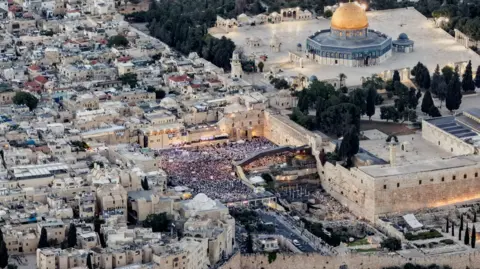
Jerusalem is a holy city for Jews, Christians and Muslims
Palestinians point out that Israeli construction permits in East Jerusalem are almost impossible for them to get. According to the Israeli human rights group Bimkom, in 2025, only 7% of new housing approved in Jerusalem was for Palestinians, who account for some 40% of the city's population. People in al-Bustan say that their efforts to reach a compromise on alternative planning proposals were rejected by the local authority.
Half of the homes here have now been demolished. Many residents facing demolition orders are opting to take sledgehammers to their own properties to avoid hefty costs and fines imposed by the municipality which typically total tens of thousands of dollars.
"We're being given warnings that in the coming months they'll destroy the rest of the houses," says local activist Fakhri Abu Diab. His home was previously demolished, and he and his wife are now threatened with eviction from the caravan they set up by the rubble.
"Israel is using the geopolitical situation to finish the issue. It's very difficult and painful and the international community has left us all alone," Abu Diab goes on. "The municipality is waging a war of bulldozers against us and our presence
Israel has built about 160 settlements housing 700,000 Jews in the West Bank and East Jerusalem.
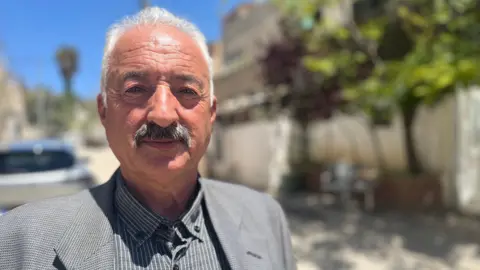
Fakhri Abu Diab's family home was demolished and now he faces eviction again
While most Israelis see all of Jerusalem as their united capital, Palestinians want the east as the capital of their hoped-for, future, independent state. The current Israeli government has pledged "to bury" the idea of Palestinian statehood – and is taking steps accordingly.
According to the UN, some 200 Palestinian households - about 900 people - are facing eviction cases filed against them in the Israeli courts, mostly by settlers.
Israel uses laws allowing takeovers of property owned by Jews before the state was created in 1948, so that settlers can move in. This is currently happening next to al-Bustan, in another part of Silwan called Batn al-Hawa. Palestinian families who have long lived there are now classed as "illegal squatters".
Israeli law does not allow Palestinians to claim back properties within Israel that they owned historically.
Silwan's proximity to a key holy site, the al-Aqsa mosque compound - or al-Haram al-Sharif as it is known to Muslims and Temple Mount to Jews – is central to its importance to Israeli authorities and settler groups. It is the holiest place in Judaism as well as the third holiest place in Islam.
"Silwan sits on a very important site called 'City of David'," says Yonatan Mizrahi from the Israeli anti-settlement NGO Peace Now, referring to an Israeli archaeological project. "Part of the plan is to create a touristic area that very much emphasises the Jewish narrative, the Jewish belonging to this land."

Israeli flags are flying where settlers live in the Christian and Muslim Quarters of the Old City
"We see more and more settlers coming in and unfortunately more and more Palestinians forced to leave."
In the Christian and Muslim Quarters of the Old City, Israeli flags mark buildings where settlers now live. A large one is mounted on the side of a religious nationalist Jewish school, or yeshiva, involved in another high-profile eviction case.
An original yeshiva here, set up in the early 20th Century, was abandoned in 1929 during major sectarian riots in the British Mandate period. But a Palestinian Muslim guard, Mohammed Basha Abdulghani, kept it safe in return for being allowed to live in part of the building.
Now, in a case brought by part of the Israeli justice ministry, Jerusalem courts have ruled that the dozen remaining members of the Basha family - most of whom are elderly - must leave. The current yeshiva argued that it needed additional space for its students.
"What will we do?" asks 76-year-old Mufid Basha, Abdulghani's son, in his tiny apartment. "We've nowhere else to go. This is the only home I've ever known."

Members of the Basha family must leave their home, an Israeli court order states
He recalls how his father was lauded when he handed over the key of the intact historic yeshiva after Israel captured East Jerusalem. Thousands of religious texts were discovered inside.
"He kept the books, kept the place - everything the same," Mufid Basha says. "And this is the gift that we get!"
The rabbi for the modern-day yeshiva declined to comment to the BBC.
Jerusalem's District Court recently issued a temporary injunction preventing the Basha family from being evicted while it considers their legal request for an appeal.
While Palestinians face being forced out of their homes in East Jerusalem, there is a shortage of places for them to move to within the city.
A recent Bimkom report also highlighted how a new land registration process introduced in East Jerusalem in 2018 was being used by the state as another tool for large-scale land appropriation and Palestinian displacement.
"Today, Palestinians in Jerusalem know that they are unsafe, unsafe even in their homes," says Aviv Tatarsky, a researcher with another Israeli anti-settlement NGO, Ir Amim. The group believes that Jerusalem should be a shared city for Israelis and Palestinians.
"With the Israeli government all restraints are off," Tatarsky continues. "They are rushing to cement a reality of a Jewish supremacy in the city that does not really tolerate Palestinian rights or maybe even Palestinian presence in Jerusalem."
 AFP
AFP
The al-Bustan area is located in a valley below the al-Aqsa mosque compound
In recent weeks, Jerusalem district planners have approved a long-delayed, highly controversial project to build a vast ultra-Orthodox yeshiva at the entrance to Sheikh Jarrah neighbourhood in East Jerusalem.
The Israeli government also set up an inter-ministry team to explore the seizure of dozens of Palestinian-owned properties by Chain Gate inside the Old City, an entrance to the al-Aqsa mosque compound or Temple Mount.
Back in al-Bustan, I join a tour of foreign diplomats. Local Palestinians are calling for the international community to stand up for international law and help them stay in their homes.
The European Union did recently issue a statement calling the situation "dire" in East Jerusalem and in Silwan in particular.
"The EU reiterates its strong opposition to Israel's settlement policy and activities," it read.
The last visit with the diplomats is to 97-year-old Yusra Qweider, who is unable to leave her bed. She has been displaced three times since 1948, when her family fled from Jaffa. Now her house of the past half a century faces an eviction notice.
"They want to kick us out of here," Yusra tells me. "I am sick and I can't walk. We are counting on God."