 2 months ago
110
2 months ago
110
Richard PriceBBC News, West Midlands

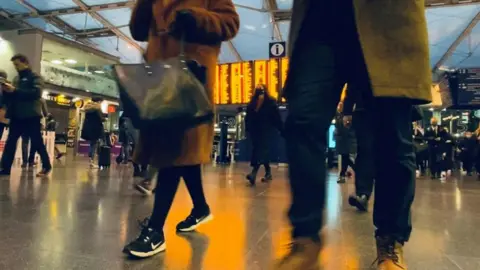 West Midlands Railway
West Midlands Trains services are transferring to public ownership from 1 February
Rail passengers in the West Midlands will see a major change to services in the region from Sunday.
The organisation is being established by the government to oversee the rail system when operators' current contracts end.
The government passed legislation in November allowing them to take rail firms into public ownership.
With the publicly owned body GBR launched, it will take over the contracts currently held by private firms in England as they expire, including WMT.
Ministers previously said they hoped nationalisation of all services in Britain would bring savings and cut delays and cancellations.
However, shadow rail minister Jerome Mayhew said he feared nationalisation could end up costing taxpayers more money in increased costs for leasing rolling stock.
Almost nothing will change immediately - except possibly the paintwork on some trains.
"There won't be any change at all straight away," according to Sim Harris, managing editor of Rail News.
He added there might be some visible changes to the livery of trains but added it was the "first step" in a longer process of reform.
It was not even certain the name West Midlands Railway would survive, he said.
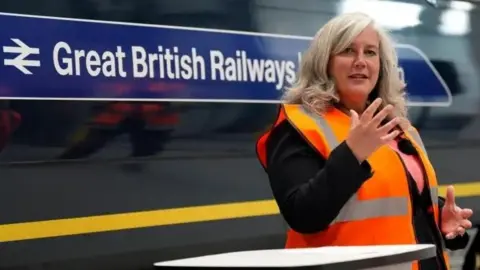 PA Media
Transport Secretary Heidi Alexander says the cost of tickets was important to passengers but they were "willing to pay for a good service"
Will rail fares get cheaper?
When the government laid out plans for renationalising the railways in July 2024, it did not guarantee lower fares, but promised a "best fare guarantee", to make sure people are always paying the lowest fare for their journey.
It has also promised its reforms would make buying cheaper tickets simpler.
Transport Secretary Heidi Alexander said she recognised that "affordability is really important to people" but that people were "willing to pay for a good service".
She told the BBC that the day-to-day running of trains was already heavily subsidised by the taxpayer.
Her focus would instead be on improving services and infrastructure, she said.
Bosses at WMT have said the change would not affect its train services, timetables or stations and that all "ticket validities and conditions of carriage" were unaffected.
The firm's managing director, Ian McConnell said he was proud of what the franchise had achieved but teams were now working towards the transfer.
"As we transition to a publicly owned railway, our focus remains on delivering an outstanding service for our passengers," he added.
During the Covid-19 pandemic, when passenger numbers plummeted by 94% during the lockdowns, the government - in effect - took control of much of the railways.
Several train companies in England moved on to contracts where they got a fixed fee to run services and the taxpayer carried the financial risk.
This also gave ministers and civil servants greater control over the day-to-day running of the railway - more so than they had in the days of British Rail.
The DfT said renationalisation would improve reliability, boost economic growth and bring savings.
But some have criticised the plans, arguing that public ownership will not make much difference unless it comes with more investment.
Mr Harris said successive British governments had not prioritised the nation's railways as much as their counterparts in places like Japan and Switzerland.
"The railway here has always been on the back foot," he added.
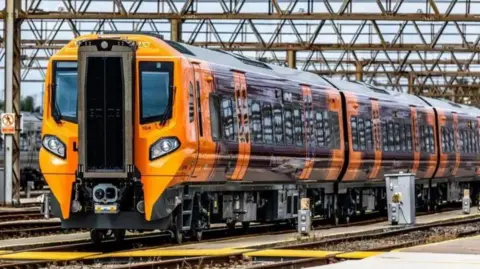 West Midlands Railway
West Midlands Trains bosses moved to reassure passengers that the change would not affect its train services, timetables or stations in the near future
When will the changes take place?
Services operated by WMT will go into public ownership on 1 February, according to the Department for Transport (DfT).
Its services will become part of GBR, which is part of the government's plans to nationalise all services in Britain to bring savings of up to £150m while also reducing delays and cancellations.
WMT, which ran both the West Midlands Railway and London Northwestern Railway brands, said it was committed to "ensuring a smooth transition" to public ownership.
Nationalisation is when something - such as a service, company or an entire industry - is brought under the control and ownership of the state or government.
From just after World War Two until the 1990s, the UK rail system was fully nationalised - with the government owning the rail networks and all of the trains.
Under the current system, rail infrastructure is managed by the publicly owned organisation Network Rail - while passenger train services are run by individual operators which are both privately and publicly-owned.
The government decided it would take over control of these services as operators' franchise periods come to an end.
The situation is different in Scotland and Wales, where passenger services are run by the devolved governments. In Northern Ireland, the system is fully nationalised.