 3 months ago
110
3 months ago
110
Suranjana TewariAsia Business Correspondent

 Getty Images
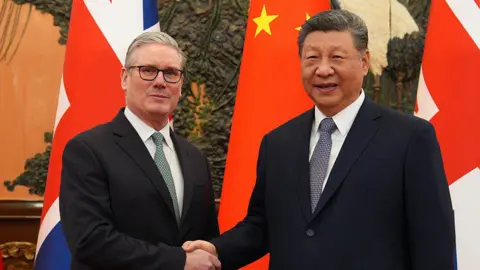
China and the UK have called for a reset in economic relations
Sir Keir Starmer's visit to China this week is the clearest sign yet the two countries are seeking to end the diplomatic "ice age" that has defined their relationship.
Both leaders face economic pressures at home and are seeking new opportunities for trade and investment.
For Sir Keir, the first UK prime minister to visit China since Theresa May in 2018, the trip was a chance to highlight the strength of British firms in finance, pharmaceuticals, healthcare, clean energy and car making.
President Xi Jinping, meanwhile, aimed to show that China can be a reliable partner for Western economies, as US President Donald Trump continues to rattle the global trading system.
Although no sweeping free trade deal was reached, the visit marked a cautious but tangible reset of UK–China economic ties.
Agreements on visas, services, healthcare, green technology and finance, combined with revived dialogue, might lead to better access for British firms to Chinese markets and greater Chinese investment in the UK.
The biggest commercial announcement came from AstraZeneca, which promised to invest $15bn (£11bn) in China over the next four years, to expand research and the manufacturing of medicines – the company's biggest investment in China to date.
In the energy sector, British firm Octopus Energy is entering the Chinese market for the first time through a partnership with local company PCG Power to develop a digital platform for trading electricity.
The project aims to improve efficiency in the power system and support China's efforts to increase the use of renewable energy.
For Octopus, which has grown quickly in the UK, the deal allows entry into China's large and growing energy market, where demand for clean energy and digital trading is rising.
Greg Jackson, CEO of Octopus Energy who was part of the UK's business delegation to China flagged that the country's scale and innovation have made solar, wind energy and batteries cheaper.
"Now there's a huge opportunity for Britain to succeed as we build the solutions that use these products to cut the cost of electricity," he added.
China also agreed to halve tariffs on Scotch whisky, a deal the UK government said could generate £250m for the British economy over the next five years.
"Our whisky distilleries are the jewel in Scotland's crown," Sir Keir said. This is "proof that our pragmatic, hard-headed international engagement brings benefits at home", he added.
Scotch whisky is a key export for Britain's drinks sector, with more than £5bn in annual exports. In recent years, China has been one of its fastest-growing markets.
Industry groups welcomed the move, saying it would help Scottish distillers compete in a crowded market where US, European and Japanese firms are also vying for customers.
Another outcome of the trip was visa-free travel for British citizens visiting China for up to 30 days for holidays and business, putting the UK on par with around 50 other countries, including France, Germany, Australia and Japan.
Both sides also agreed to cooperate on disrupting migrant-smuggling networks, a top priority for Sir Keir's government.
For Beijing, renewed ties with the UK - a major European economy and close US ally - signal that China remains a dependable partner for the West despite Trump's trade tensions.
Economically, the reset secures access for Chinese exporters of high-value goods such as electric vehicles, solar panels and clean energy, while creating opportunities for Chinese investment in British services, finance and green tech.
Chinese state media framed the visit as a step toward turning the "potential of China–UK cooperation into real achievements that benefit both peoples and the world".
British firms were also quick to emphasise the benefits for both countries through the expanded partnerships.
"The prime minister's visit, the first in eight years, is a significant moment, signalling the importance of the economic relationship between the UK and China," Chris Fitzgerald, group director for international affairs at Octopus Energy told the BBC from China.
"Such partnerships mean we can bring affordable, secure, clean energy to British customers... And we can use our technology and know-how to bring some of the same benefits to Chinese customers."
Foreign businesses have long complained about the difficulties of doing business in China, flagging red tape, complex regulations, and a lack of transparency.
These can complicate investment decisions and create uncertainty for companies.
"Any market has its own challenges, so of course we've got to be clear eyed and seek expert advice," Fitzgerald said.
"We have had good discussions with the Chinese officials who have welcomed our entry. And we have been careful to choose an excellent partner... So we are excited to take the immense opportunity that the world's largest renewable energy market offers."
Sir Keir's Labour government has struggled to deliver the economic growth it promised, making the China visit a high-stakes test.
Despite scrutiny at home, improving relations with the world's second-largest economy has been a priority for the British prime minister.
The move, however, requires a delicate diplomatic balancing act.
US President Trump recently warned that Canada could face 100% tariffs over deals struck with China during Mark Carney's visit, and he has warned the UK about deepening its commercial ties with Beijing.
Sir Keir has insisted that Britain does not need to choose between Washington and Beijing, framing the reset as a pragmatic way to support growth at home while managing geopolitical risk.
At the UK–China Business Forum in Beijing on Friday, he described meetings with Xi as "very warm" and highlighted the significance of agreements on visa-free travel and whisky tariffs.
These offer British firms "really important access" and are "symbolic of what we're doing with the relationship", he said. "That is the way that we build the mutual trust and respect that is so important."
Sir Keir's visit is one of a flurry of trips to Beijing, as leaders from France, Canada and Finland seek to hedge against an increasingly unpredictable United States.
With Washington pursuing aggressive tariff policies and even making threats over Greenland, these so-called middle powers are looking to diversify trade and investment partners while securing new markets.
At the same time, these countries will be watching closely the deals that the UK, Canada, France and others are striking with China.
They will all need to remain competitive in attracting Chinese investment and accessing the world's second largest economy.