 3 months ago
101
3 months ago
101
Laura BlaseyBBC News, Washington DC
Watch: 'She's done a great job' - Donald Trump praises Melania's film
From televised cabinet meetings to late night Truth Social posts, US President Donald Trump has rarely stepped out of the spotlight since he resumed office in January. But more often than not, he's done it without his wife. So where is Melania?
A new documentary co-produced by the first lady herself aims to answer that question. Melania: 20 Days to History promises viewers an intimate glimpse into Melania Trump's life in the days leading up to her husband's January 2025 inauguration.
The film opened in cinemas across the US on Friday to controversy. It has received significant attention from administration critics and watchdogs, who have criticised the project's funding and dismissed the timing of its release as insensitive, as mass protests swell over two fatal shootings by federal agents in Minneapolis.
Politics aside, those seeking answers about how Trump spends her time might find the film unsatisfying - much of it shows Melania Trump in transit, at public events or drifting between meetings to review fabric samples and dinnerware.
Still, small interactions with her closest friends offer some glimpses at how the famously enigmatic first lady is approaching her husband's second term.
"Everyone wants to know, so here it is," she says in an opening voiceover. Here's what we've learned from watching the film - and what we didn't.
Fleeting off-script moments
Early on, Trump is clear about her intent: "I want to show the American people my journey from private citizen to first lady," she says.
The film touches briefly on the controversy around its creation, in a meta moment that shows Trump's staff fielding an inquiry from a journalist about its commission.
Melania is a co-production from Trump herself and director Brett Ratner, along with other partners and distribution by Amazon MGM Studios. The film is Ratner's first project since he was accused of sexual misconduct at the height of the #MeToo movement in 2017. Ratner has denied the allegations.
Much of the film takes place at Trump Tower in New York, at the president's Florida residence at Mar-a-Lago or en route between the two. We see little of either property, just the spaces in which Trump meets with her trusted staff of stylists, event planners and interior decorators.
At several points, Ratner intervenes to prod Trump into sharing more about herself. What kind of music does she like? Michael Jackson is her favourite, she reveals during a car ride to the airport - especially "Billie Jean", which plays twice during the film. The pair listen to the song and she briefly sings along.
"Are we doing Carpool Karaoke with Melania?" Ratner excitedly asks.
Her most personal struggle
Trump is most candid about her mother's death, describing the grief as overwhelming. Amalija Knavs died in January 2024.
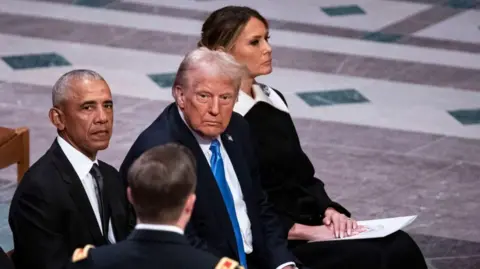
She first opens up to an interior decorator, when discussing plans for the Trump family to move into the White House. Her grief appears to swell when she attends the funeral of former President Jimmy Carter in Washington DC on 9 January 2025, the anniversary of her mother's death.
She describes sitting in the Washington National Cathedral, present for Carter but "my beloved mother will be on my mind". Knavs, she says, was the "richest thread of my life".
Donald Trump remarks to the camera that his wife had a "hard time" with her mother's death.
After the funeral, Melania Trump proceeds directly from one cathedral to another, St Patrick's Cathedral in Manhattan, to light a candle in her mother's honour.

 Getty Images
Melania Trump attended the funeral of President Jimmy Carter alongside her husband in 2025
Inside her small inner circle
Her husband Donald Trump appears sparingly, emerging at key events and in a handful of private moments to praise her.
Perhaps her warmest relationships are seen with her long-time stylist, Hervé Pierre, and France's First Lady Brigitte Macron.
"I go everywhere with you, we are connected on many subjects," Macron tells her.
While Donald Trump and French President Emmanuel Macron have navigated a rocky relationship, the two first ladies praised each other in a video call to discuss their mutual concern with youth anxiety and social media use.
In contrast, her meetings with Pierre, who designed many of her looks for the inauguration, focus on finer details - an eighth of a inch on a collar or the cut of a lapel. When asked about her friendship with Pierre, she says the two have worked together for years because they have "great energy and vision" together.
Pierre tells the camera that he feels they speak the same language - the language of details and design, owing to Trump's history as a model and her strong opinions on how her clothes fit.
What we don't see is the wider Trump family, or its dynamics. The Trump children only appear in the crowd at his swearing-in. Though Melania Trump speaks warmly of her son Barron, he appears to avoid the camera - abruptly walking away when the family enters the White House together.
"It is very important that he lives the life he wants to live," she says.
 Getty Images
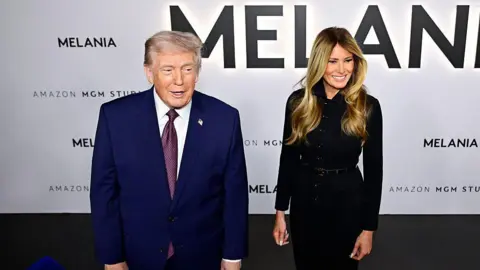
Donald and Melania Trump both attended the film's premiere at the Kennedy Center
Complicated role of first lady
Throughout the film, Trump hints at discomfort with her new role, at times seeming to mourn the loss of her privacy and freedom to the rigid and public obligations of being first lady.
The role of first lady is "more structured" and comes with "fewer quiet moments", she says, and she feels she must stay "mentally strong".
The documentary hints at the tumult of the 2024 presidential election and the toll of Donald Trump's campaign. But Melania Trump largely avoids offering her own perspective.
She directs much of the attention back to Donald Trump, echoing her husband's public statements that he has endured grave injustice. "Nobody has endured what he has for the last few years," she says in a voice over. "Here he is, I'm so very proud."
She describes her job as first lady as one of juggling obligations.
"You have your schedule, the White House schedule, the president's schedule," she says. "You need to be a mother, wife, daughter, friend."
Watching the news, she expresses genuine sadness at reports of a tragedy or children with high screen time, but holds off on offering opinions or specific policy goals as first lady.
She views footage of the Palisades fire burning in Los Angeles, lamenting the cost to "the families". The scene cuts to her walking into a meeting with Aviva Siegel, an Israeli woman who was taken hostage in the Hamas-led attack on Israel on 7 October 2023. Her husband Keith was still in captivity at the time of filming, but was later released in Feburary 2025.
Trump hugs Siegel as she cries. "I will pray that he doesn't suffer," she says, noting that her husband will be in office in a few days' time and could help.
"I will always use my influence and power to fight for those in need," she says.
 Getty Images
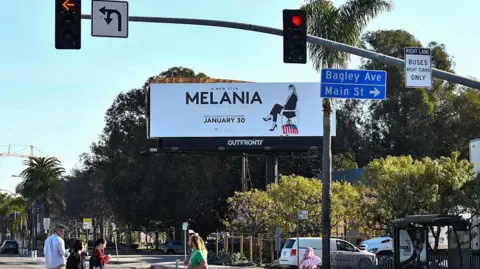
The documentary is being given a theatrical release before going to a streaming platform
Reactions divided by politics
Documentaries have become a key part of the celebrity PR toolkit in the last decade. Where social media can be unpredictable, self-produced documentaries by the likes of Taylor Swift, Demi Lovato and Selena Gomez offer a revenue stream, fan service and a unique degree of image control, all with the promise of intimacy.
At a Friday afternoon showing at a cinema outside of Washington DC attended by the BBC, the audience was filled with a mostly older crowd dressed in American flag attire who cheered and clapped throughout the film.
This is part of why Trump may have chosen this kind of project, says Katherine Jellison, a women's studies professor and expert in first ladies at Ohio University.
"As she said in her own memoir, she resents that others defined her the first time around," Jellison told the BBC.
But unlike the glossy productions before it, the film's ties to the Trump administration - and more importantly, its politics - have coloured perceptions even before its release.
A private screening at the White House attended by conservative influencer Erika Kirk and Apple CEO Tim Cook came hours after federal agents shot and killed Alex Pretti in Minneapolis.
Critics of the Trump administration labelled the opulent event as insensitive and out of touch. In Los Angeles, protesters vandalised public transit advertisements promoting the film. On review websites, they posted scathing ratings before the film was even released - a practice known as review bombing.
The film's funding by Amazon has also drawn criticism, at a time when several billionaires and business leaders, including the company's founder Jeff Bezos, have sought to strengthen their ties to the White House.
According to media reports, Amazon spent $35m (£25m) on marketing, on top of around $40m for the rights to the film. Industry veterans have described it as an uncommonly expensive documentary.
But in the film itself, Melania Trump seems to largely remove herself from the political concerns of the White House, preferring to focus on the fine details of the dinners and dresses to come. In one moment, Donald Trump calls to encourage her to watch a recent appearance of his.
She declines, in a moment that drew chuckles in the cinema - "I will see it on the news," she tells him.
Her final take on her position, offered towards the end of the film, describes the role as an exercise in personal growth: "As First Lady, the real nobility is becoming stronger than the person I was yesterday."