 2 months ago
100
2 months ago
100
Georgina RannardClimate and science reporter

 Getty Images
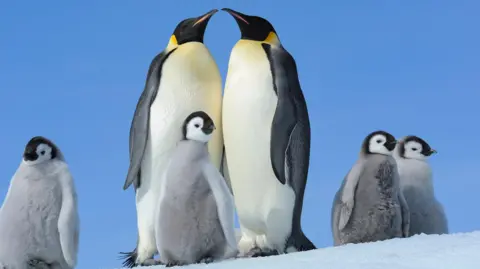
Emperor Penguins are likely more at risk from climate change than any other air-breathing Antarctic animal
Scientists have discovered that an annual event when Emperor penguins completely shed and regrow their feathers is putting the birds in peril as Antarctica is transformed by a warming world.
Each year the birds must stay on platforms of floating ice for long enough to replace weather-beaten feathers with new, waterproof coats.
But in 2022-24 Antarctic sea ice shrank significantly, largely down to climate change, depriving the birds of safe places to moult.
Now scientists who track the animals using satellite pictures can no longer find most of the birds. They fear that thousands of penguins may have frozen in Antarctica's icy waters.
"This was really an "oh my God" moment," says the scientist behind the findings, Dr Peter Fretwell at British Antarctic Survey, who has worked on Emperor penguins for 20 years.
"You could see this was something game-changing for Emperor penguins. Suddenly you're thinking, well, have we got time to save them?" he says.
The research, published in the scientific journal Communications Earth & Environment, provides evidence about the impacts of the collapse in Antarctic summer sea ice in 2022-24 which the BBC reported on here.
It is focussed on West Antarctica, home to 30-40% of the global population of Emperor penguins. The animals are amongst the most threatened in the world.
They migrate thousands of kilometres to find stable sea ice during Antarctic summer to wait out what is called a "catastrophic moult" every year.
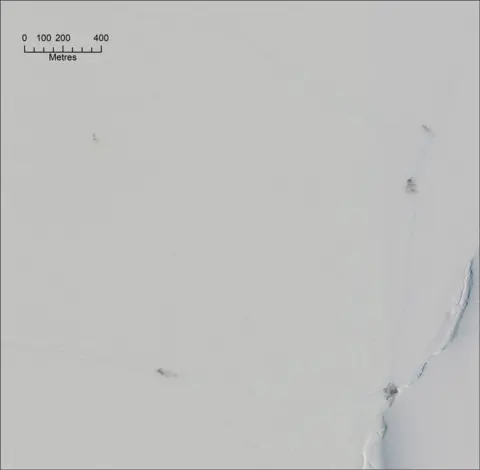 Peter Fretwell
On vast white sea ice, the blobs of brown are feathers left behind by penguins as they moult
Little else was known about the 30-40 day moult, until Fretwell spotted large brown smudges in satellite pictures from 2019-2025. They turned out to be mounds of feathers, left in an area called Marie Byrd Land.
The penguins' feathers are "the most complicated and best insulating of any animal", he says. Over time they are damaged, so the penguins shed them annually.
"It's incredibly energy-intensive and the birds use up to 50% of their body mass," he says.
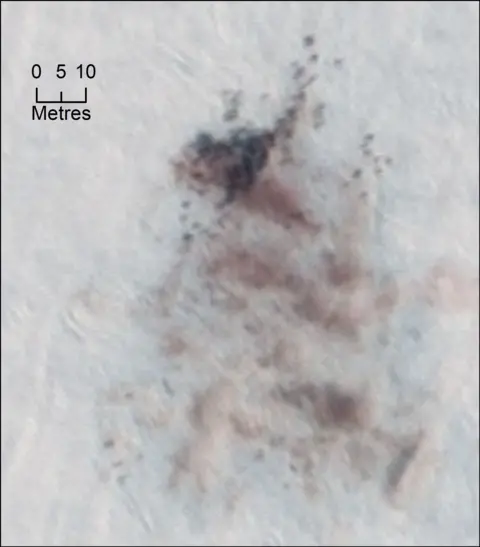 Peter Fretwell
Scientists identified extensive mounds of brown feathers in satellite pictures
It is "probably the most dangerous time for adult Emperor penguins because they haven't got their waterproof suits on," he says. If they go into water, they are likely to die.
In 2019, 2020 and 2021 the sea ice was relatively stable and significant feather mounds were visible.
But in 2022 summer sea ice in much of Antarctica dramatically shrank, falling from an average of 2.8m sq km to a record low of 1.79m sq km in 2023.
That trend continued until 2025, when there was a modest recovery in the sea ice in West Antarctica.
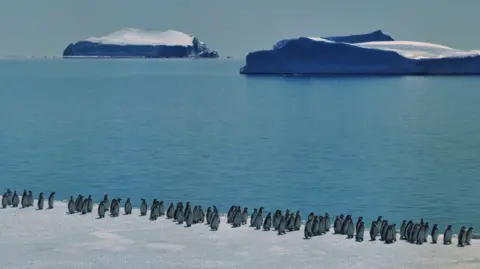 Getty Images
Researchers fear that most Emperor Penguins colonies could be wiped out by 2100
But when Fretwell looked at the satellite pictures, he saw few signs of the birds.
"There should have been lots of penguins there, but actually we could only see 25 groups," he said. Groups vary in size from 10s to up to 1,000 birds.
"Again this year the sea ice hasn't been too bad, but I can only see a handful of penguins really," he says.
He fears most have could died. Some may have travelled to another location in East Antarctica to moult, but this would have disrupted breeding, also leading to population losses.
Longer term, the bird's best chance for survival is to adapt to moult on shallow ice shelves. Fretwell has seen some groups begin to do this, although it may come with a cost to the penguins' breeding and feeding patterns.
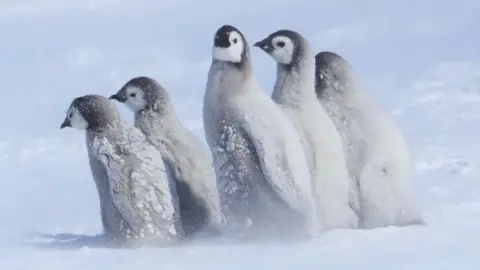 Peter Fretwell
He says the findings are a reminder that while the effects of global warming can be slow at times, there are moments of dramatic change.
"It wasn't just a few colonies that were lost and it wasn't a slow process," he says.
"It is the only piece of science I've ever done that's really emotionally got me," he says.
Next he will compare his findings with an imminent population count of Emperor penguins in the Ross sea region where the birds migrate to and from. That will give more data about the possible numbers of deaths.
He says the results could change predicted extinction dates for Emperor penguins.
"Now I'm asking, is that coming forwards towards us? Is it the end of the century?" he asked.