 3 months ago
157
3 months ago
157
4 hours ago
Joe InwoodWorld news correspondent

 Getty Images
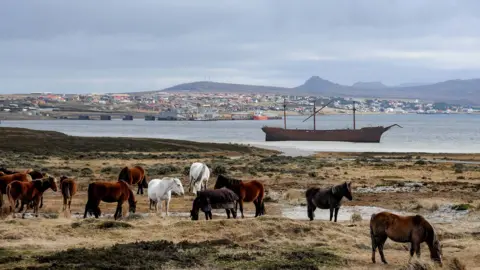
Whalebone Cove in the Falkland Islands
If you need evidence of the geopolitical waves caused by the US war with Iran, the fact that they have now reached the shores of this remote archipelago provides it.
For as long as the sovereignty of the Falkland Islands, known in Argentina as Las Malvinas, has been an issue, the official US position has been one of neutrality, while recognising de facto British control. Unofficially, however, they have offered diplomatic and, on occasion, military support to the UK.
This was most evident in the events surrounding the Argentine invasion of 1982, which cost the lives of 255 British servicemen, three islanders and 649 Argentinian personnel.
The initial US response was to attempt shuttle diplomacy. When that failed, they offered intelligence support, as well as advanced missiles, to the British.
In a BBC documentary in 2002, Richard Perle, assistant US defence secretary at the time, said: "Britain would probably have lost the war without American assistance. That's how significant it was."
The decision to side with the UK has never been a straightforward one, however. Many in the US have an instinctive hostility to what they see as a colonial hangover and the desire to maintain influence in Latin America.
This conflict could be seen in a declassified CIA report from the time, which said the US support for the UK could mean that "relations with several countries (in Latin America will) probably will be cool for a few years". But, that same report also discussed what it called "the special nature of the historical US bonds with the British".
Since then, a lot has changed. Those bonds have been tested like never before, with US President Trump openly hostile to Sir Keir Starmer following his reluctance to join the war in Iran.
At the same time, Donald Trump has found a geopolitical soulmate in the form of Argentina's President Milei. The two men speak warmly of each other, sharing ideological similarities as well as a personal style.
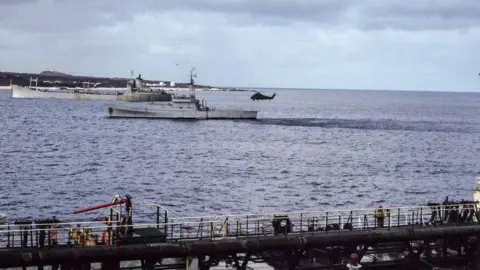 Getty Images
Ships from the British naval task force during a stop on the way back from the Falklands War, 1982
This all comes as the US has also explicitly shifted its focus away from Europe and towards what it calls the "Western Hemisphere" – the Americas.
If the US did change its position to one in which it supported Argentinian claims over the islands, that would be "pretty significant", says Ed Arnold from Royal United Services Institute (RUSI), as "it might cause other countries to move that way as well".
"You could potentially see a situation where Argentina pushes for some intervention at the UN and the US may support or just not actively block," he said.
According to James Rogers from the Council on Geostrategy, "American diplomats consistently water down or block resolutions pushing Argentine sovereignty" at both the United Nations and the Organisation of American States, a pan continental forum.
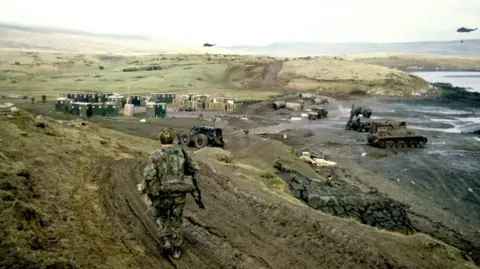 PA Media
UK soldiers on 21 May, 1982 at San Carlos Bay using the area as a general landing point for supplies and equipment
The Falkland Islands are considered by the UN to be a "Non-Self-Governing Territory" - and are subject to ongoing discussion by the "Special Committee on Decolonization", which has encouraged discussion between the British and Argentineans.
That has long been resisted by the British, who consider the islands to be sovereign territory. That position is supported by the islanders themselves, who voted overwhelmingly in a referendum to remain part of the UK.
Speaking at a UN event on decolonization, Phyl Rendell of the Legislative Assembly of the Falkland Islands pointed out that "when the Falkland Islands were first settled in the mid-1750s onwards, it was indeed a colony; just as neighbouring Chile, Argentina and Brazil were populated by settlers from Europe and other parts of the world". In short, to the islanders, this is a dispute between two post-colonial nations.
For Ed Arnold, from RUSI, the important thing to look for is what form, if any, the US change in position takes. "If it comes from Trump, it'll make the headlines, but that doesn't necessarily mean the US machinery of government is moving for a change".
Despite the unprecedented level of control the president is taking over parts of government, that does not automatically feed through to the minutiae of policy: "There's still a lot of bureaucracy that will probably want to keep business as usual."
Changing that takes more than a presidential executive order, says Arnold, with "everything else that's happening in the U.S., this isn't going to be a presidential priority".
Undoubtedly, this story will be making far greater waves in the UK than in the US, and in the end that may be the intention.
President Trump has repeatedly demonstrated his desire to use transactional diplomacy to pressure both allies and adversaries.
He will know that the Falkland Islands is a pressure point for the UK but irrelevant to the US, which for him is an opportunity for leverage.