 2 months ago
120
2 months ago
120
1 hour ago
James CookScotland editor

 Getty Images
Devolution was designed by Labour and delivered by Labour but the political era it ushered in has been dominated by the Scottish National Party.
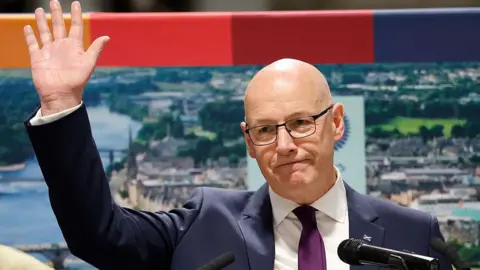
As the sun dipped behind Holyrood at the end of a long day's counting, SNP leader John Swinney told me his party had won the election "hands down."
Describing the margin of victory as "significant and emphatic," Swinney insisted "the public expectation" was now for him "to be returned as first minister and to lead a government."
The SNP leader said he would work "to find common ground" with any party except Reform UK, which he described as having "completely different values" to his.
"People are feeling fragile. Times are tough. The world is a place in turmoil and I think what people want is a first minister who will bring people together," he told me.
Whatever the outcome of those chats, it is clear that Swinney is comfortable with the idea of minority government and of negotiating with most rivals on an issue-by-issue basis.
As we spoke outside Holyrood, a small crowd holding saltires and placards had gathered calling for Scottish independence in word and song.
The strains of Flower of Scotland could be heard drifting across the parliamentary pond.
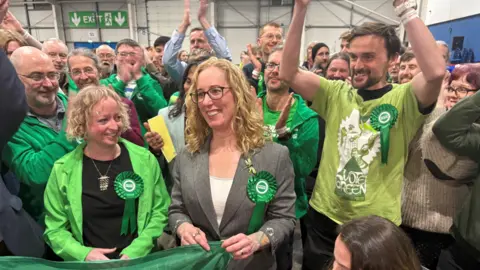
The singers will be heartened by the fact that there is – once again – a pro-independence majority here. It comprises 58 SNP MSPs and 15 jubilant Scottish Greens, a record haul which puts them just behind Labour and Reform UK, who were tied on 17 apiece.
Indeed, he repeatedly talked up the prospect of outright victory, a very high bar in a parliament where the electoral system is designed to make minority or coalition government the norm.
He did not come particularly close to achieving that aim. While this was obviously a clear victory for the SNP, and a remarkable achievement after 19 years in power, it was not the wholesale endorsement he had sought from voters.
The SNP's vote share fell as did its total number of seats, down from 64 to 58, well short of the 65 needed for a majority in the 129 seat parliament.
The party also endured some painful constituency losses.
 PA Media
Lorna Slater's win in Edinburgh Central was the first time a Green has won a constituency seat
Privately, senior SNP figures admit they profited from Reform UK becoming a serious player in Scottish politics, further fracturing the pro-union vote in a country where the constitution remains a dividing line even though it has slipped down the electorate's list of priorities, according to pollsters.
When it comes to reviving the cause of independence, Swinney knows that confidence in SNP governance and support for leaving the UK are, to an extent, linked.
He has already spent two years trying to stabilise his party after a period of turbulence, which included the departures of Sturgeon and Humza Yousaf as first ministers, a police investigation into the finances of the SNP and a series of policy rows.
He now insists his party has rebuilt public trust but he has also indicated there is still work to do.
When I asked what would be his priority on returning to government, Swinney did not mention independence, instead promising to "deliver practical support on the cost of living" and "concentrate on continuing the improvements in the National Health Service."
For most people, these will be worthy aims in and of themselves. But it seems clear that Swinney also sees them as necessary to provide a stable platform from which to press the independence case.
Twelve years after a referendum in which 45% voted for Scottish independence, polls put support for leaving the UK at around 50%.
The polls also suggest that the prospect of Reform UK leader Nigel Farage entering Downing Street – hardly an outlandish idea now after his party's gains across Great Britain – would push support for independence even higher.
The issue may yet roar back on to the agenda in the campaign for the next general election, which must be held by August 2029.
As for Scottish Labour? This was - yet again - their worst showing in the history of devolution.
When the last result was eventually declared in Inverness in the wee small hours, in a counting centre littered with empty pizza boxes, there was not even a crumb of comfort for the party.
 PA Media
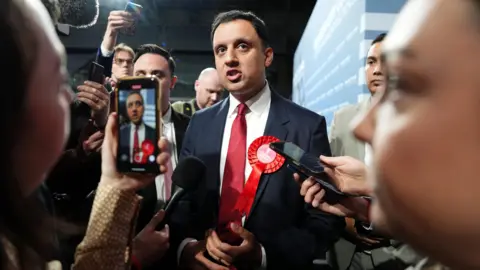
Anas Sarwar conceded early in the day that Labour had not won the election
Scottish Labour leader, Anas Sarwar, knows he could have been a contender for first minister.
It's just two years since his party swept the SNP aside in the general election. But since then he has been dragged down by a deeply unpopular prime minister.
Even a call for Sir Keir Starmer to quit wasn't enough for Sarwar to avoid a disastrous performance that will see his party scrapping with Reform UK for priority at Holyrood in offices, seating arrangements, and speaking opportunities in the chamber.
"We advocated for change. We didn't win that argument," said Sarwar.
The Conservatives also had their worst ever Holyrood election, a dismal result for leader, Russell Findlay. The Labour-Tory duopoly which once defined UK politics feels like a distant memory in 21st Century Scotland.
With dozens of new faces arriving at Holyrood in the coming days and weeks, including a big bloc of brand new Reform UK MSPs, the next parliament will be a very different place.
And those new parliamentarians will have plenty to grapple with.
Scotland, like the rest of the UK, is enduring a long period of faltering growth, high inflation and rising welfare bills, all of which are putting public services under intense strain.
Covid, Brexit and austerity have all had an impact too.
Add in to the mix the potentially transformative effect of artificial intelligence - for good or ill - and the next few years are likely to be extremely challenging for politicians of all stripes.
A period of change seems to lie ahead. But some things stay the same and, as they contemplate entering a third decade in power, it is SNP politicians and their supporters who are celebrating this weekend.