 2 months ago
82
2 months ago
82

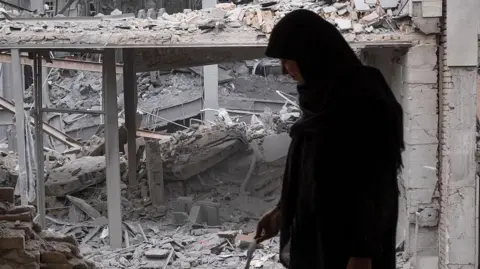 NurPhoto via Getty Images
A woman searches for her belongings in her destroyed flat in Tehran
Zahra is cleaning the windows of her flat for Nowruz, the 3,000-year-old festival marking the arrival of spring and with it the start of the Iranian New Year.
A grandmother living in a Tehran suburb, Zahra would normally be looking forward to a Nowruz family reunion. But not in this time of war. With the internet blocked by the regime she struggles to maintain contact.
"My children are restless. Not being able to hear their voices is driving me insane. This is truly the height of cruelty and oppression for a mother."
Zahra is an Iranian voice whose name we have changed to protect her from official retaliation. One of those Individuals who would face persecution if their identities became known to their own government.
They want to speak to the world but can only do so if we disguise who they are and their exact whereabouts.
Those secretly sending material to the foreign media know how risky it can be.
Quoting the words of Iran's ministry of intelligence, the US-based Human Rights Activists News Agency said 10 people were recently arrested for "co-operating with foreign media" and two others for "creating psychological insecurity in society through cyberspace".
This is the reality of life in Iran at war - nearly four weeks since the country was attacked by the US and Israel.
But using trusted sources on the ground, the BBC has been able to obtain testimony from a range of Iranians in different parts of the country.
What emerges is a picture of anger, grief, and growing fear as the number of reported deaths climbs towards 3,000 - more than half of those civilians.
Outside Zahra's home, the residue of "black rain" left after US and Israeli strikes on oil depots covers the ground.
"Everything in the courtyard had been blackened by oil. We no longer have visits or gatherings, but symbolically, we must prepare ourselves, clean our homes, and welcome Nowruz. Perhaps this dark night will finally give way to dawn."
When asked if she wants a ceasefire, Zahra is scornful.
"This regime has inflicted so much pain on us over the past 47 years leaving countless mothers without their children, more than even the war itself did. So, I prefer that there be no ceasefire until this entire regime is gone."
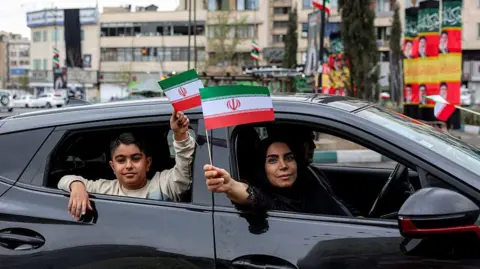 AFP via Getty Images
A woman and child wave Iran's national flags from a car in Iran's capital
The government's supporters routinely fill the streets to denounce the US-Israeli campaign.
In the current climate of censorship and the strain imposed by war it is impossible to gauge how much popular support there is for regime change.
The brutal massacre of thousands of anti-regime demonstrators in January has left a major trauma.
Samar [not a real name] - a student in Tehran - says that because the government's most fervent supporters believe in a "culture of martyrdom" there is a risk of civil war if clerical power is overthrown.
"It means they're willing to die but not let the regime fall - because they think its fall means the end of their religion. That's how effectively the regime does brainwashing."
Samar shares the popular view that for every senior official "they've reportedly assigned three to seven successors. Like a hydra - you cut one head off, another grows back. They won't surrender any time soon."
She wants to see the end of the current regime - but stressed the range of factors that motivate its support base and make change so difficult.
"They [the regime] created several different lines of thinking. And every supporter is attached to one of them.
"One is what I just said [religion]. Some are influenced through patriotism and the idea of an enemy. Some through fear of the country breaking apart."
Asked if she is hopeful, Samar replies: "Wherever I look, it's a mess. Even if Pahlavi [the son of Iran's last Shah] comes and tries to form a new government, I think these people will start suicide attacks. They won't back down."
Our sources in Iran were also able to interview a young man who is due to undertake military service.
In his early 20s, Ali [not a real name] recently lost a close friend in an air strike on the army base where he was stationed.
"I heard that they had bombed that place. After that, I found out that my friend had been killed. I could not believe it myself. I called the other friends, and they told me, 'Yes that friend of ours has been killed.'"
Ali spoke of another friend who narrowly escaped death, and another who had deserted.
Every male over the age of 18 is required to serve.
"You must go... They come after you. They take you from your house. If they see you outside the house, they take you with them," he says.
But Ali says he will not serve. He is not an ideological young man. He simply doesn't want to be killed.
"I definitely won't go because my life would be in danger. Whatever I can do, I will do so that I don't go into military service."
For now, the state retains the repressive power, military capability and a strong enough support base to continue fighting.
Any ceasefire will likely leave the current rulers in place and capable of surviving - at least in the medium term.
An escalating war could unleash a far more unpredictable dynamic for the regime and the people of Iran.
Additional reporting by Alice Doyard and Josh Cheetham, BBC Verify.