 1 month ago
46
1 month ago
46
Lyse Doucet,chief international correspondentand Lina Shaikhouni,BBC World Service, Syria

 BBC
BBC
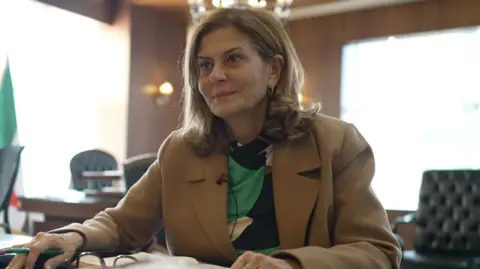
Hind Kabawat says she would not stay in the role if she was not free to set her own strategy
"On the first day, I asked 'why are there no more women?'," says Hind Kabawat.
She is Syria's minister for social affairs and labour - the only female minister in the transitional government tasked with navigating the country's jagged road from war to peace.
Sectarian violence, which has killed thousands of people, has marred its first months in power, with many of Syria's minority communities blaming government forces.
Once an opposition leader in exile, Kabawat acknowledges the government has made mistakes since President Ahmed al-Sharaa's rebel forces swept into the capital on 8 December 2024, ending decades of the Assad family's brutal dictatorship.
But she insists "mistakes happen in transition".
Kabawat also says one of the president's biggest mistakes has not been appointing other women in his cabinet, though she says he has assured her there will be more.
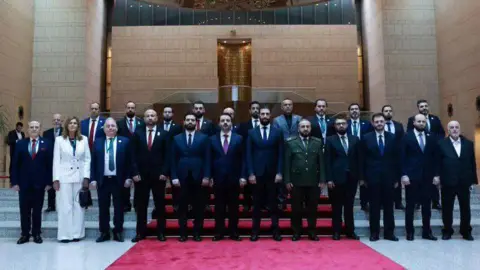 Syrian Presidency
Kabawat is part of President Ahmed al-Sharaa's transitional government, appointed in March last year
In his cabinet - which is dominated by his close comrades and some former fighters - she faces a challenging juggling act.
We followed Kabawat for our special report for the BBC's Global Women and saw up close how her array of dossiers cover Syria's most vulnerable, including orphans and widows, as well as the grieving families of the tens of thousands who disappeared during Assad's regime.
Another pressing priority is to create jobs and find homes for the millions displaced during nearly 14 years of civil war, and easing the suffering of those fleeing the latest clashes among communities.
Everything is urgent in a broken country - which is also broke. The United Nations says 90% of Syrians live below the poverty line.
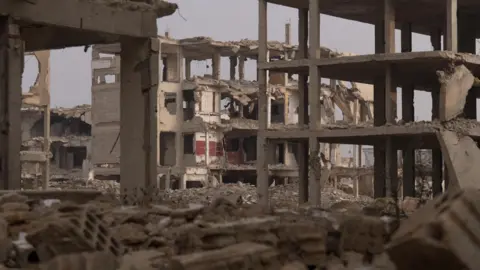
The World Bank estimates that rebuilding Syria will cost at least $200bn (£145bn)
In early January, Kabawat rushed to the northern city of Aleppo to visit shelters harbouring thousands of people after fighting flared between government forces and the Kurdish-led Syrian Democratic Forces (SDF) who have long dominated north-eastern Syria.
Last summer, she tried to bring aid into a southern city populated mostly by Druze after it was torn by deadly violence between Druze, Bedouin and Syrian government forces.
And she reached out to the family of an Alawite woman, from the same minority Shia sect as the Assad family, who accused armed men in military fatigues of rape.
There are some complaints Kabawat could do more to help mend the fractures between Syria's different communities.
Asked if the government made mistakes in its response to the sectarian violence, she replies: "Mistakes happen in transition, in post-conflict; no-one is happy about it, including the president."
But she stresses an inquiry was set up, and now "many of those who committed those crimes are in prison".
Understanding how to build trust, and peace, has defined much of her working life. Educated at universities in Syria, Lebanon, Canada and the United States, Kabawat is a lawyer and negotiator who played a leading role in the exiled Syrian opposition during the civil war.
In her own arsenal, she sees her sharpest tool as dialogue.
"It's taking time for people to say 'we trust you' after 50 years of dictatorship," she explains, emphasising that trust is needed "people to people" as well as between government and the population.
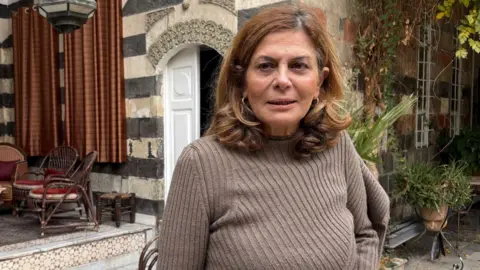
"I see the suffering of the people... and feel responsible for their pain," says Kabawat
We travel with her to the provincial capital of Idlib in the north-west, the former rebel stronghold of Sharaa's Hayat Tahrir al-Sham forces.
She worked here during the civil war, with Tastakel, a women-led organisation she founded. Its name translates roughly from Arabic as "becoming independent" - which also sums up her philosophy on building this new Syria.
In a packed, brightly-lit hall, young and old women, and some men, from across Syria, are gathered to celebrate the end of the old order, and to strategise about strengthening the role of women at all levels of decision-making.
For Kabawat, it is about taking responsibility.
In recent indirect elections for the new transitional parliament, or People's Assembly, not a single woman was elected from Idlib. Overall, only 4% of seats went to female candidates.
"You should have been united and thought in a politically intelligent way to ensure we got one or two women elected," she scolds the women.
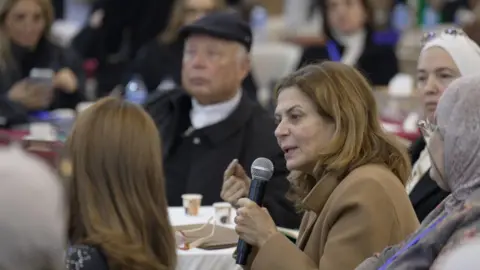
Kabawat encouraged people at the conference to be more politically strategic in promoting women for election
You could feel the energy coursing through the room of well-spoken women, some wearing tightly wrapped headscarves, others in head-to-toe veils, and some -including Kabawat - bare-headed.
This has always been the female face of Syria, a society often described as a mosaic of many traditions. Initial concerns that stricter Islamist rules would be imposed by Sharaa and his supporters, who adhere to a strict interpretation of Sunni Islam, have not materialised in the main, but worries still linger for some.
Sharaa himself, a former al-Qaeda commander-turned-Islamist rebel leader, has shucked his military fatigues for a tailored Western-style suit and now positions himself as a pragmatist.
Kabawat says that on that first day, when he announced his government in March last year, the president assured her more women would be appointed. "He said: 'It's coming, we are in transition,'" she adds.
Any suggestion she is a token woman in his ranks meets a firm rebuke.
"I am not here for window dressing," she declares. "I don't feel that I am a Christian or a woman when I do my job. I feel like I am a citizen of Syria... The minute I start feeling like I'm a minority or I'm a woman, I will lose my legitimacy."
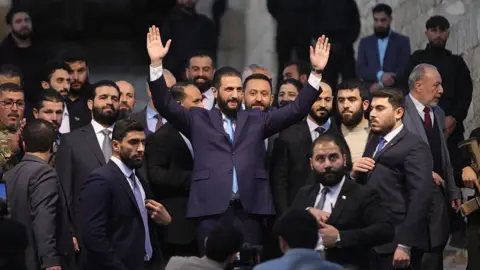 Nabieha Altaha/Anadolu via Getty Image
Previously an Islamist rebel leader, President Ahmed al-Sharaa now positions himself as a pragmatist
At the conference in Idlib, there's a sudden sign of a changing society. Kabawat is ambushed by an enthusiastic crowd of young women talking excitedly over each other - former students from her Tastakel classes.
"We're implementing the mission she taught us and we are trying to acquire more expertise so we are ready," says one of them, Siwar.
Kabawat exclaims in approval as another, Ghufran, wags her finger for emphasis: "We either occupy a space where we hold all the decision-making power, or we don't want to be in that space at all."
Even in deeply conservative Idlib, women of an earlier generation played leadership roles in civil society during the war.
Softly-spoken and exuding confidence, Ahlam al-Rasheed is now the director of social affairs in the provincial government.
Nearly a decade ago, in 2017, she earned a place on the BBC's 100 Women list with her work promoting women's rights.
During the civil war, women "led across several sectors, including in politics, relief, education and health", she says. Many were - and still are - the main breadwinners in their families.
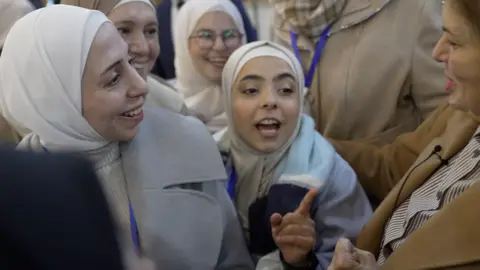
Ghufran (centre), one of Kabawat's former students, stresses that women should hold decision-making power
We travel to a bleak tented camp on barren land on the edge of the city, where we see the reality of what Rasheed says is the biggest challenge facing Syrian women now.
This camp, and countless others dotting the country, house millions of Syrians whose homes still lie in utter ruin.
Kabawat briefly greets the robed and suited men standing in line to receive her. Then she makes a beeline for a gaggle of giggling children and expectant women, most in flowing black cloaks. The jaunty wool cap pulled over her honey-brown hair may be her nod to both the cold winter weather and more conservative ways.
Inside a tented mosque, she sits on the floor listening to a litany of woes from women, many of them widows, living in grinding poverty and pain, without assistance.
Again, Kabawat throws it back to them, asking who would like to be taught to make handicrafts to be sold internationally. A sea of hands rise.
Then, she is on her way, leading a "choo-choo train" formed by a line of delighted children, sprinkling humour, happiness and even a little hope, but not the real aid they so desperately need.
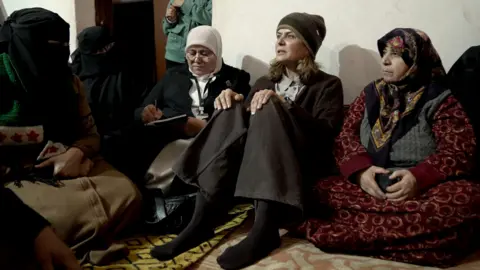
Kabawat (centre) listens as she hears about the difficulties facing Syrians whose homes have been destroyed
Later I ask her what she said to the man who lamented that he had worked so hard in the opposition but was still living in a tent.
"Of course, they're right," she reflects. "I feel their pain." She highlights the urgent need for "a united effort from the international community".
I point out that donors say the government also has to move more quickly to establish a new legal system, as well as transparency.
"Of course, they're not right," she shoots back. "We inherited a country which was completely destroyed and we're working on laws to renew and adapt a new country - so it's taking time."
Her tone is even more emphatic when I ask about reports that Sharaa's inner circle is now creating a shadow government by taking away ministers' power to appoint their own deputies.
"I won't be here the minute I see that I can't appoint my own deputy and don't have the freedom to make my own strategy," she declares. "Nobody controls me."
Sharaa "cannot rely on one side", she adds. "If he's not going to be inclusive and bring many people together in the government… we can't survive."
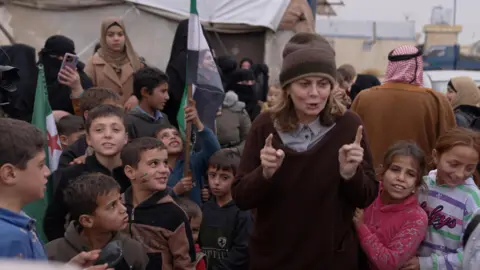
Kabawat interacts enthusiastically with people in the camp, but has little to offer them in terms of aid
Post-Assad Syria has received hundreds of millions of dollars in aid from many countries.
An American push - with President Donald Trump's personal backing - has helped lift crippling sanctions.
But the World Bank estimates that Syria will need at least $200bn (£145bn), just to rebuild its shattered landscape. And some donors are hesitating because of volatility in the country and wider region, exacerbated by Israel's repeated attacks on its neighbour.
Israel says it is acting against perceived threats posed by Syria's armed groups.
As we sit in Kabawat's graceful living room, among framed family photographs and sprays of Syria's new flag, her can-do composure breaks for a moment.
"I see the suffering of the people... and feel responsible for their pain," she admits, wiping a tear. She says when she feels she does not have the resources to help people, that is the one time she asks herself "why did I do this?"
Then there's a rustle outside the door. Another delegation is waiting to see her.
"Khalas [enough], enough of tears," she vows. "It's another day and it's back to work."
Viewers in the UK can also watch the interview on Global Eye at 19:00 on Monday 2 February on BBC Two or on iPlayer

- This is part of the Global Women series from the BBC World Service, sharing untold and important stories from around the globe