 2 months ago
93
2 months ago
93
Daniel BushWashington correspondent

 EPA
EPA
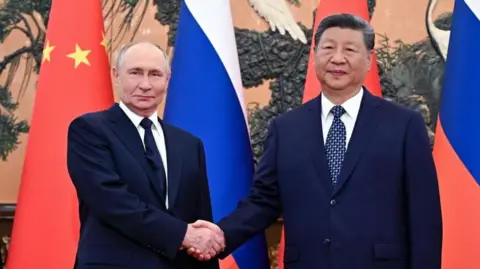
President Trump hopes to strike an arms control deal with Russia and China's leaders
President Donald Trump has said he can replace an expiring US-Russia arms control deal with a better agreement that includes China, a move that would upend a decades-long arrangement between the world's biggest nuclear powers.
But as Washington and Moscow seek a path forward following the expiration of an Obama-era treaty on Thursday, former senior US officials and analysts warned that a new deal could take years and face major hurdles if the administration wants China and Russia to cooperate.
The expiration of the Strategic Arms Reduction Treaty, known as New Start, left the US and Russia without major guardrails on their nuclear weapons programmes for the first time in the 21st Century.
The development has raised concerns of a new nuclear weapons buildup pitting Russia and China against a Western alliance which has shown signs of cracking since Trump's return to office.
"We are not turning our backs on each other" yet, Rose Gottemoeller, the chief Obama administration negotiator for New Start, told the BBC in an interview. But "it is a dangerous moment nevertheless, because there is nothing planned. What are the next steps going to be?"
US and Russian negotiators this week appeared to be nearing a deal to abide by the expired New Start restrictions. Trump's envoy Steve Witkoff and son-in-law Jared Kushner reportedly led arms control negotiations with Russia during talks in Abu Dhabi on the Ukraine war.
But a temporary agreement now would likely not include the same level of transparency as an official long-term treaty, several former senior US officials said.
The compliance and verification rules that underpin arms control treaties between the US and Russia typically take years to negotiate and couldn't be quickly hammered out by Trump's top negotiators, former officials and analysts who work on nuclear nonproliferation said.
"This is not something that Steve Witkoff and Jared Kushner and Marco Rubio can do on the back of a cocktail napkin," said Lynn Rusten, a former senior National Security Council and State Department official who worked on New Start.
The arms control showdown comes in a moment of heightened tension as Moscow has drawn closer to Beijing amid a standoff with the West over the war in Ukraine.
Trump has repeatedly spoken in favour of nuclear arms control in his second term, part of a self-styled peacemaker agenda that Trump is hoping can net him the Nobel peace prize.
But Trump's insistence that China be involved in new arms control talks could stymie progress towards a deal. Beijing has said it won't start negotiations until the US and Russia reduce their nuclear weapons arsenals. It's also unclear how tensions over Ukraine will impact arms control talks between the White House and the Kremlin.
While Trump has said China must be involved in new arms control talks, White House officials have discussed taking a two-track approach with separate negotiations between the US and Moscow and Beijing, according to a person outside the administration with knowledge of the matter who asked not to be named.
A White House official told the BBC that Trump would set out the best path forward on nuclear arms control "on his own timeline".
"President Trump has spoken repeatedly of addressing the threat nuclear weapons pose to the world and indicated that he would like to keep limits on nuclear weapons and involve China in arms control talks," said the official, who spoke on background.
Trump called for a "new" arms control treaty in a social media post on Thursday.
"Rather than extend "NEW START" (A badly negotiated deal by the United States that, aside from everything else, is being grossly violated), we should have our Nuclear Experts work on a new, improved, and modernized Treaty that can last long into the future," Trump wrote.
 Reuters
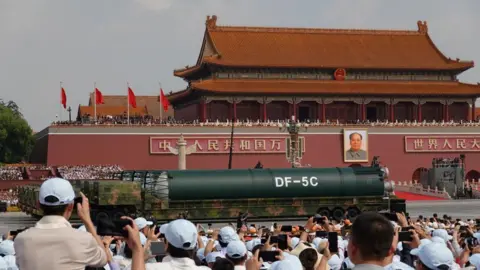
China displays an intercontinental strategic nuclear missile at a military parade in Beijing last summer
The new period of uncertainty isn't entirely unprecedented. Before the collapse of the Soviet Union, Washington and Moscow went through some brief periods without a major arms control treaty in place. Under President Jimmy Carter, the US delayed ratification of a treaty to protest the Soviet Union's invasion of Afghanistan. Both countries agreed in the interim to abide by the terms of the uncompleted treaty and it later went into effect.
The situation is more complicated today because of the strained relationship between the US and Russia over Ukraine, analysts said, as well as by China's emergence as a nuclear-armed superpower - dynamics that have raised the stakes and put pressure on Trump to deliver a new arms control deal.
But the US and Russia appear to have deep disagreements about how to replace New Start.
The deal capped the number of deployed strategic nuclear warheads at 1,550 for the US and Russia. The 2010 agreement also created a system of on-site inspections and data sharing so the countries could monitor each other's nuclear weapons arsenals. It replaced the original Start treaty - signed by the US and the Soviet Union in 1991 - that limited both sides to 6,000 deployed nuclear warheads.
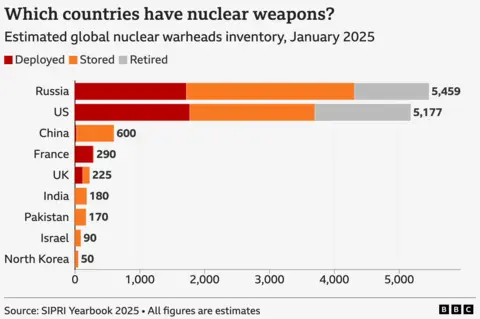
Today Russia has 4,309 deployed and stored nuclear warheads and the US has 3,700, according to the Stockholm International Peace Research Institute. The nations combined hold almost 90 percent of the global inventory. China has 600 nuclear warheads, but the figure is expected to grow to as many as 1,000 by the end of the decade.
The US and Russia stopped conducting on-site inspections of each other's nuclear weapons facilities in March of 2020 at the start of the pandemic. Moscow suspended the New Start treaty in 2023, citing America's leading role in the international coalition backing Ukraine.
Russia has repeatedly said it won't rule out using unconventional weapons in response to Nato aggression, stoking fears of a nuclear war in Europe. It hasn't made good on the threat, but since starting the war Russia has twice fired an Oreshnik missile into Ukraine. The missile can carry conventional or nuclear warheads.
There is currently no arms control treaty in place restricting the use of shorter-range "tactical" nuclear warheads in Europe.
Last month, Trump signalled he was comfortable with letting the treaty expire. "If it expires, it expires," he said in an interview with the New York Times. "We'll just do a better agreement."
Russia said on Wednesday ahead of the treaty's expiration that it was "no longer bound" by New Start restrictions on deployed nuclear warheads.
"We assume that the parties to the New Start treaty are no longer bound by any obligations or symmetrical declarations within the context of the treaty," Russia's foreign ministry said in a statement.
Even if both sides reach a stopgap agreement, experts said the prospects of a long-term arms control treaty remained murky.
"There could be a political handshake agreement to extend New START's central limitations [but] there is no indication that that would include verification measures," said Stephen Herzog, a professor at the James Martin Center for Nonproliferation Studies.
Years of arms control policy now hang in the balance, Herzog added. The lapse of New Start, he said, disrupted "a legacy of more than five decades of bilateral nuclear arms control."