 3 months ago
101
3 months ago
101
Lyse DoucetChief international correspondent

 AFP via Getty Images
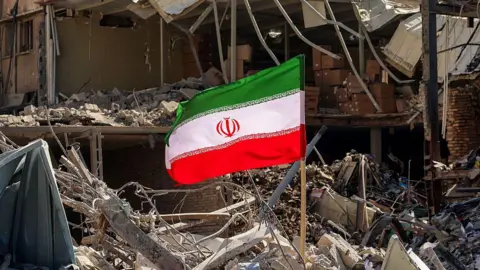
The US president who likes to keep the world guessing about his endgame in Iran is now telling the world what he wants.
In a war widely described as his "war of choice", Donald Trump says he also wants to choose who will rule Iran now that its Supreme Leader Ayatollah Ali Khamenei, and dozens of others clerics and commanders, have been assassinated.
That seems unthinkable for a clerical regime rooted in deep distrust of America - among its most ideological elements there is burning hostility towards the country they labelled long ago as the "great Satan".
Whether Iran's embattled leadership would be mindful of choosing a top cleric willing to work in a different way with Washington is not clear.
There has long been division between factions known as reformers and pragmatists, and the hardliners who call themselves Principlists in their defence of their revolution.
But they are united on one goal: the survival of the system which keeps them in power.
One week into this existential battle, the hardliners still seem to be holding sway.
In his latest remarks, the US president then made it clear that he would only choose "a GREAT AND ACCEPTABLE leader" after Iran's "unconditional surrender".
There is no sign of that either.
Trump's latest musings seem to underline that his current goal is not regime change, but a change in the regime – although he is known to veer in his views from one day to the next.
It is a stance which will let down Iranians who dared to hope that the end of the top cleric would pave the way for the end of his Islamic Republic.
"I have to be involved in the appointment, like with Delcy (Rodriguez) in Venezuela," Trump told the Axios news website and Reuters in telephone interviews.
He has repeatedly referenced the US's military action in Caracas on 3 January as the "perfect scenario" for Iran. His forces extracted its leader Nicolás Maduro, suffered no casualties and caused no chaos.
Delcy Rodriguez, who took over the top job, is now working with the US administration.
Iran's theocracy - with its multiple layers of political, religious, and security institutions, honed and hardened through decades of external threats and internal discontent - is not that kind of system.
A foreign plot to put a preferred leader in charge more than a century ago is still seared in Iranian memory.
In the 1953 coup, America's CIA intelligence agency and Britain's MI6 conspired with Iranians to overthrow the democratically elected Prime Minister Mohammad Mosaddegh.
The man they put in place, Shah Mohammad Reza Pahlavi, was later toppled in the 1979 revolution, an event shaped by suspicion of Washington, as well as London.
Trump also seems to have made up his mind about who he does not want to be in charge.
"Khamenei's son is unacceptable to me," he said of 56-year-old Mojtaba Khamenei, a hardliner now being widely tipped as the front-runner to succeed his father.
The retort from Tehran was predictable.
The president's comments reflected "the depth of the enemy's malicious objectives in this battle", according to the conservative Mehr News Agency, which carried a rebuke from members of the interim Leadership Council now in charge until a new leader is announced.
"The great Iranian nation will never allow anyone to interfere in its internal affairs and its right to determine its own destiny," it declared in the fiery war of words now amplifying this grievous confrontation on the ground.
Iran's own process of picking its own leader is secretive in the quietest of times. In the din of the deafening blasts of American and Israeli bombs, there are conflicting reports.
Reports have swirled in the media that the younger Khamenei has already been anointed by the Assembly of Experts, a grouping of some 88 senior clerics tasked with this responsibility.
The buildings in Tehran and Qom where they were meant to meet were bombed this week but they are reported to be meeting virtually.
Mehdi Khalaji, a senior fellow of the Washington Institute for Near East policy, said: "I'm not sure if it has already happened because yesterday there was news that the interim Leadership Council announced they had the authority over announcing war and peace, which means they are waiting for the succession to be finalised."
Khalaji, the author of a biography of the late Ayatollah Khamenei, told the BBC about the late leader's second and most prominent son Mojtaba: "Khamenei is an enigmatic person but we know he represents the most hardline faction of the regime's security apparatus, the Islamic Revolutionary Guards."
He added that Khamenei "also needs the acceptance of the clerical establishment" but says he does not have it.
It was reported a few years ago that the supreme leader had ruled Mojtaba Khamenei out of the succession to avoid the hereditary rule of the ousted monarchy.
There has also been a growing assumption that Ayatollah Ali Khamenei would be Iran's last truly supreme leader with the legitimacy and authority to be the ultimate decision-maker.
It is the powerful Islamic Revolutionary Guards Corps (IRGC), created in 1979 to protect and preserve the Islamic Republic, which now dominates all its levers of power, from security to the economy.
There are reports that the Assembly of Experts could chose a council of leaders rather than one person to preside in this perilous time.
Other names are reported to be in the running, including Hassan Khomeini, the most prominent grandson of Iran's revolutionary leader, Ayatollah Ruhollah Khomeini.
Regarded as a relative moderate in the clerical establishment, he had taken on a more public role as tensions built in the run-up to war.
There has also been mention of the senior jurist Alireza Arafi, who now holds one of the three positions on the interim Leadership Council - but his life spent mainly in Islamic seminaries is not being seen as the right CV for this job.
It is not even clear that the successor will be announced, since Israel has made it clear that whoever emerges will also be an "unequivocal target".
The only person speaking often and openly about this highly sensitive choice is Trump, who has remarked: "Most of the people we had in mind are dead."